Saturday, July 12, 2008

"Hey Bill Moyers, are media really all that bad?"

"Our media institutions, deeply embedded in the power structures of society, are not providing the information that we need to make our democracy work. To put it another way, corporate media consolidation is a corrosive social force. It robs people of their voice in public affairs and pollutes the political culture. And it turns the debates about profound issues into a shouting match of polarized views promulgated by partisan apologists who trivialize democracy while refusing to speak the truth about how our country is being plundered."

Thus speaks Bill Moyers, prize winning PBS TV journalist, sometimes described as the inheritor of the Edward R. Murrow tradition.

Bill Moyers has long been the president of the Schumann Center for Media and Democracy and the host of Bill Moyers Journal on PBS.

He was giving the keynote address at the National Conference for Media Reform Conference in Minneapolis on June 7. You can read more on Moyers at his PBS website.

Bill Moyers laments the decline of journalism and labels it a "Fifth Column" undermining democracy.

*****************

In my youth as a journalist with The Christian Science Monitor Bill Moyers was an esteemed name -- a journalist and clergyman and Lyndon Johnson staffer once again turned journalist.......

He is still a much respected icon, speaking out for the prophetic tradition of watchdog journalism, where reporters and editors "speak truth to power."

I personally called him while covering the 1976 Patty Hearst trial to discuss issues surrounding "mind control" and "brainwashing."

Today's Bill Moyers falls back on many "liberal" anti-corporate cliches -- oversimplifying the world between good and evil. Even though he does not use the Bushian term, "Axis of Evil."

Those who seek to gain the public's attention -- be they in journalism, movies, vaudville, or the circus -- have long hyped and hawked their wares to catch public attention. Wide media circulation sells advertising. Advertising supports media.

But government run media can also have problems of corrupting the truth by enforcing the party line.

This is not the kind of government media Bill Moyers knows. For at government subsidized PBS Moyers has had the freedom to "preach to his choir" -- even with plenty of corporate underwriting.


Yes, media today reflects lots of corporate power, consolidation, etc., especially at the local level.

Cost cutting downsizing of coverage at both local and international levels is legion. But journalism has always been highly intertwined with profit, with its making money in tension a bit with the idealistic ideology of freedom of the press.

Yet looking back, few journalists have been gods and few pure icons free from spin.

Anyone who studies the history of journalism knows there has been no truly "Golden Age" -- and that journalists were rarely high enough in heaven to become "fallen angels."

On balance I would say we suffer as much today from media anarchy, of information overkill, as we do from censorship or consolidation.

When one surveys the entire spectrum, the diversity and free flow of information is massive. The trumpets have sounded, and lots of walls have come tumbling down.

While some traditional journalism sectors have weakened, the world has come alive with an irrepressible bubbling of global information.

In my youth the door to China was dark and closed. Today I can see and read almost every pimple in the "Middle Kingdom."

God, Bill, the old days were nice......but, Hey, ain't it Grand Today?


******************

Partisanship and opinion spewing are massive today -- blatant Republican on Fox cable (Bill O'Reilly's "The Factor") ; blatant Democratic on MNBC (Keith Olbermann's "Countdown"); blatant populist nativism on CNN (Lou DobbsTonight).

Bill, we are in full agreement. Vituperation, opinion, spin are the hallmarks of today's journalism, especially on television where the competition for viewers and advertising is so keen.

Fear and ideological polarization are the hallmarks of much electronic media, both creating and pandering to the deep emotions of our times.

But to blame everything on corporations is to miss the forest for the trees.

Sensationalism and hype are nothing new. Indeed they are a major tool in the arsenal of the "rabble rousing" journalist -- whether it be to drum up popular support for a war or to gain attention for needed social reform.

In our history they are deeply established in the sensational but often reformist tradition of "yellow journalism" and our equally strong tradition of attacking "yellow journalism" as a corrupter of public discourse.

In time of war, nationalism, fear, and propaganda have long determined that "the first casualty of war is truth." It was no different once so many in this nation yearned for revenge following 9/11. American journalists seemed proudly "on team."

So it has been in almost every war, both in the United States and overseas. Until the pendulum swings, popular attitudes shift a bit, and media see profit and headlines in undermining the official view. That is when segments of the journalism world feel the freedom and the inclination to go "off team." That is when journalism's skepticism is most like to clash with the military's goal of "staying on mission."

But, Hey Bill Moyers, it takes a while to get there.

As for the information that would have undermined the President's case for war, so very much of it was out there for anyone who wished to see.

Rarely have the nuances of intelligence analysis been so open to the public. Rarely have the uncertainties of intelligence analysis been so publicly available. Rarely had the murky miasma surrounding Saddam Hussein been so apparent in news reports, books, and widely on the internet.

Yet rarely have Americans, including the media, felt so under threat as in the aftermath of 9/11. It was a "perfect storm" for war.

To complain that American media did not stop the Iraq war is the height of foolishness. What wars in history were truly stopped in the beginning by media?

Media are so often among the first to climb on board. In times of patriotic fervor who wants to be left behind to face stoning by the mob? Governments have long known how to exploit this.

Do some wars never happen because of media? Perhaps...If there is a "perfect storm" for peace.

There is nothing new about pack journalism and groupthink whether blindly following a drive toward war or mindlessly challenging every official account once a long war grows unpopular.


******************

Yes there are now, as then, "stuffy" bastions where credibility and balance still are valued.

Even within the cable TV outlets I cite above one can find vast, relatively untainted, news delivery where a bit of balance is still a part of marketing appeal.

Often it is far more than corporate greed which shapes the product. For example the dominance of fast moving visual imagery fed by modern technology and public hunger for images of "reality."

Nothing sells like the visual excitement of a hurricane or a massacre.

So entertainment, hype everywhere coexist with an avalanche of information. Yes, Bill, nothing is sacred. Neither the sins of the present nor the alleged saintliness of the past.

As always, lots of things are "spun." On TV, on the internet, in blogs such as this.

"Just the facts, ma'am" has often given way to a gush of unverified opinion.

But, Bill, like many of the rest of us, you have grown a bit righteous and rigid.

That is our prerogative.

We who are growing old have a tendency to romanticize the past.

God, it was nice......but, Hey, ain't it Grand today?

Saturday, January 26, 2008

"Catch a Predator": yellow journalism as vigilante


"To Catch a Predator" is a type of programming quite familiar in US journalism history.

Generally it is known as "yellow journalism," a type of journalism designed in the late 19th Century to increase circulation and advertising by appealing to popular tastes and fears . It focused on "shockers" -- the kind of crimes which violated contemporary tastes and taboos.

It may or may not be your cup of tea but there is no doubt MSNBC is daring, innovative and in this grand tradition -- evoking many of the same journalism controversies as did earlier "yellow journalism."

William Randolph Hearst and Joseph Pulitzer were, of course, its most famous practitioners.

The coverage focused on the kind of crimes gaining prominence in urban America, crimes which drew public concern, partly because papers covered them so prominently when competing for circulation and advertising.

In many cases these kinds of "yellow journalism" became "a part of the story."

Still I have not seen 19th Century instances where newspaper reporters enticed would be criminals into actually committing crimes in a sting operation --- as is routine on Dateline's "To Catch a Predator."

"Yellow Journalism" newspapers tended to operate independently of the police. Dateline co-operates with police -- partly to increase its credibility and respectability. Any doubts about Dateline's entrapment methods, any sense by viewers that it is a extra legal operation tend to dissolve when seeing clear co-operation between Dateline and police.

It is this "sting" quality that set "To Catch a Predator" apart. MSNBC staffers conspire to lure would be predators into computer chat with someone claiming to be underage, then invite the would be criminal into a trap where he is invited to visit the decoy.

The person lured in is then publicly humiliated on camera, then allowed to leave to be tackled and arrested by heavily armed police alerted in advance of the MSNBC "sting."

Whatever happens later in the court system, the on air display of the person lured into the sting administers a form of extrajudicial punishment. It can culminate in loss of job, loss of marriage, loss of children, or, always a possibility, suicide.

This, of course, can be seen as a form of "vigilanteeism" executed BEFORE a rustler steals a horse. Where Dateline appears to truly make journalism history is in deliberately setting up the "sting." In taking upon itself the power to be police, judge, jury, and executioner.

The dramatic police arrest, usually caught on camera, allows MSNBC to portray itself as an anti-crime outfit helping to rid the streets of child predators, persons who would still be at large were it not for MSNBC broadcasters.

The collaboration between MSNBC broadcasters and police has brought charges of conflict of interest, violations of due process, and collaboration with "vigilantes." These issues are examined in detail in an investigative video report posted on YouTube.

It is important to note that the decoy pretending to be under age "comes on" as a willing partner. But given the stigma attached to the "child predator" in today's America, on camera display of a person who responds to the decoy amounts to a private broadcasting corporation taking upon itself the power to mete out one of the severest punishments possible in America today.

The second stage of punishment comes in posting on the web pictures and details concerning those who fall for the internet decoy bait.

In the classic days of 19th Century "Yellow Journalism" on at least one occasion a reporter broke a case -- and the paper boasted how it had outdone the police. The strategy of competing with haphazard, careless, or corrupt police was carefully showcased with front page promotions designed to boost newsstand sales.

Pulitzer and Hearst chains sometimes assigned their reporters to compete with or supplement police investigations of sensational murders or "mashing" (harassment) of working women on the way to the job.

The "Yellow Journals" were truly "mass" in their appeal to large numbers of residents of growing American cities, literate readers with relatively little education and "low brow" tastes.

While later decried by journalism reformers as base and money grubbing, yellow journalism in anecdotal, featurish form sometimes spotlighted the need for reform amid the ills of America's changing times.

MSNBC prominent evening coverage of prison life is a dead ringer recreation of the Hearst/Pulitzer approach. In more than one case "Yellow Journal" reporters disquised as convicts reported from within prisons. In one famous instance a photograph of a woman reporter sitting in the electric chair was prominently displayed.

"Yellow Journalism" focused on many aspects of grassroots life and crime -- whereas its higher brow competitors spotlighted in more abstraction politics and public affairs geared toward the educated and the affluent.

MSNBC's evening crime coverage is squarely in the "Yellow Journalism" tradition. Its daytime programming on politics and economics dilutes the yellow dimension but seeks to make more entertaining the serious topics which could be seen as "elite."

Where Dateline appears to truly make journalism history is in deliberately setting up the "sting." In taking upon itself the power to be police, judge, jury, and executioner.

Think of it as a form of "Yellow Journalism" turned "vigilante."

Saturday, January 19, 2008

Yesterday's high tech becomes today's "retro"


Yesterday's high tech becomes today's "retro."

We sometimes forget how revolutionary the effects of technological change can be.


High tech from the past is ignored as obsolete. Even more telling, few are aware of just how great an impact today's high tech can have on the outcome of past events.


Take the Cell Phone.


How many understand just how important this technology we now take for granted was in shaping Union victories in the Civil War?


Take some Time Travel, with apologies to Mark Twain:


Scouting the Civil War with Cell Phones
The day Ambrose Burnside "Drove Old Dixie Down:"

Four forgotten hours help shape the world


Wednesday, December 19, 2007

Wagons West: ignorant armies still clash by night


How much the family of my German Jewish father took its heritage and mindset from Europe. At a time when America plunged deep into the heart of Europe via two World Wars -- all the while absorbing millions of European immigrants -- high, low, in the middle.

Even though my father, Arthur, was born on a new frontier -- in Guatemala in 1897 of a German Jewish dry goods merchant, Albert, who immigrated to America in the 1880's.


My grandfather railroaded to San Francisco, rejected the West as a place with little opportunity, before setting up business in Guatemala City. Then coming east to bring his family home to New York City circa 1902.


My father grew up a child of Europe in America's East.

In the last century European ways of thinking (Freud, Marx, as well as more classical studies) deeply penetrated our universities and political movements. Our power and energies allied with Europe against a Russian political religious movement whose prophet, Marx, was a German Jew.

It seemed no American could be truly educated without reentering and studying the belly of the mother from which he/she sprung.

Only "now" perhaps has "push back" really picked up steam.

*********

The other powerful strain in American history was the push west, expansion, wagon trains, the Mexican War -- the China trade -- and of course the marines and businessmen (such as in a small way my grandfather) who pushed south to influence, create hegemonies in Latin America.


Perhaps no one played as great a part as President James K. Polk in turning an offshoot of Europe into a great trek west. We, who sprung from Europe, spent little time studying this "father" of the Mexican War. For my generation it was sometimes fashionable to look upon this frontier son of North Carolina and Tennessee with embarrassment for stealing America's future from Mexico's past.

*********

I find it interesting how some friends of mine, the children of immigrants, know little of American history in the times before their ancestors came here.


For some such people the folk music and culture of the Sixties was a way of connecting with that deep American tradition which sprouted before the turn of the century European immigrants came. Even as our generation marched separate from America, we could "pretend" to connect.

So I, a child of the Cold War, took off in the other direction -- to the West. To the University of California at Berkeley to study the mysteries of "Communist China" -- China, where Europe and the US at one point uneasily co-existed in the years before Japanese and American expansions collided.

It was this collision of non European dragons which merged with, perhaps decisively, the Second World War.


Looking back, those of us who were products of the Cold War.....A strange time when the "enemy" the government funded us to study seemed opague, distant, as behind a screen -- through a glass darkly.

Now there is but one superpower -- no doubt strategically overextended -- but that only time will tell. Many centers of power and culture co-existing amidst the technologies of communication and globalization......


It is a world convulsing still in minor struggles -- throwing sparkling and often misleading images of both color and darkness all around the globe.
The images change so fast it is sometimes hard to tell day from night.

Amid the shifting sands of faith and doubt are seeds for both the secular and the fundamentalist. It sometimes seems the more the communication, the more the confusion and fear.

And so, as it seemed to Matthew Arnold, trapped in the Nineteenth Century "loss of faith," it can seem so still:

*********

And we are here as on a darkling plain
Swept with confused alarms of struggle and flight,
Where ignorant armies clash by night.

Wednesday, December 12, 2007

A tale of two families: dry goods to cell phones


Oddly enough, while researching the website of Carlos Slim Helu, the Lebanese Mexican telephone mogul who rivals Bill Gates as the world's richest man, I found this photo of the dry goods store La Estrella de Oriente (“the Star of the East”). His father, Don Juan Helu, started it just before World War I.

Juan, who came to Mexico in 1902 at age 15 to avoid the Ottoman draft, married Dona Linda Helu, a Lebanese woman in 1926, He fathered Carlos in 1940.

Carlos, who owns much of Latin America's cell phone industry, runs America Movil, which runs Tracfone, a prepaid cell phone company with millions of customers in the United States.

His recent setback was the collapse of Comp USA in which he had a controlling interest.

This picture of the store struck me as incredibly familiar. Had I seen it before? Then I looked to the right of my desk at that fragmented, delicately framed photograph of my German Jewish grandfather Albert -- in his Guatemala City dry goods store, circa the beginning of the last century.

The stores and the way the staff stand look almost exactly the same -- except Don Juan's store appears a tad bigger, more employees, and more heavily stocked!!!!

Ah, if only.

If only my grandfather Albert, who left Germany for the United States in the 1880's to avoid Bismarck's draft, had stayed in Guatemala with his German Jewish wife. Instead he returned to the US circa 1902 to continue his work in dry goods!

Perhaps today I would be running a cell phone empire!!!!

Instead of only using a Tracfone.

Saturday, December 01, 2007

Politicians: careful when you reset that clock!

Despite all the mutual saber rattling between the U.S. and Iran, don't let the politicians and pundits scare you about a world war erupting between proud Iranians and arrogant Americans.

So many modern confrontations take thirty years to heal. Peace could break out around 2010.

The Korean War, beginning in 1950. did not formally end until the United State and China established diplomatic relations in January 1979.

The Vietnam War, also born in the Fifties, but taking off in open military confrontation betwen the US and North Vietnam in 1965, did not really end until formal military and intelligence exchanges in 2005. The seeds of accomodation were apparent at least ten years earlier.

The American Iranian "proxy war," beginning with the taking of American hostages in November, 1979, should run out in about 2010 -- unless trigger happy politicians on both sides fail to read this blog -- and take military action to set the thirty year clock back to "year one."

True, some conflicts stretch longer. The "Cold War" between the United States and the Soviet Union stretched more than 40 years from 1948 to the collapse of the Soviet Union in 1991. So the Iranian American "proxy war" could last as far into the future as 2020.

All depends on how many times politicians on both sides set back the clock.

One trick to managing these conflicts is patience and balance -- so that after thirty years the ticking alarm clock awakens us comfortably to the morning sun.

A few bad dreams are natural. Rabble rousing, fear mongering, provocation for domestic political advantage, saber rattling, mutual vilification. For politicians of many nations these are as normal as "apple pie."

But they could get out of hand.
If the politicians are not careful, they could set the clock back to "year one."

Thursday, June 28, 2007

Escaping the tyranny of the last big war

Is Iraq a Vietnam style "quagmire" to escape from --- as the advocates of speedy withdrawal often claim?

Or is it -- like Vietnam --- a place where defeatists undermine a war effort by trying to cut funds when perseverance could bring victory?


We live in the "post Vietnam era" where we often look at the world through the searing prism of the last big war.

Yet Iraq must be understood in its own terms, illuminated by experience of the past but never forced into rigid molds of other times and other places.

For that could blur the lens of clear perception and boost the power of emotional propaganda.

**************************

It is nothing new -- this tendency to view a current war through the lens of a war in the past.

Civil War officers often saw that conflict through the lens of the Mexican and Napoleonic Wars. So they sent forth their men in frontal charges to be cut down by long range artillery and rifled muskets.

World War I commanders were late to see that machine guns and barbed wire made the tactics of earlier wars of movement even more obsolete -- at least for a time.

After World War I, France's defense planners relied upon a defensive Maginot Line which failed to see that tanks and aircraft would restore a war of movement and make barbed wire and trenches obsolete.

*******************

The challenge, I have learned, is never to be transfixed by one limited historical experience -- but to keep the mind and heart open to "all things under the sun."

*******************

I faced it as a journalist with The Christian Science Monitor -- when my reporting was sometimes partly influenced by how I was raised.

The dim echoes of World War I still sounded in my ears. My father was a convert to Quakerism who was born in 1897 and raised in a socialist/pacifist tradition. For him the "Great War" seemed not a triumph of right over wrong -- but a collapse of civilized reality before an uncontrollable man made plague.

Military power coupled to secret alliances seemed an agent of irrationality in the service of special, often blind interests. So my father joined the merchant marine to escape the draft.


Many after World War I felt the need to limit military power and overseas involvements to prevent a repeat of World War I.

in the post WWII era I was raised in a family which stressed the lessons of WWI. Indeed I cut my teeth in the 1950's studying the diplomatic and military lessons of WWI by studying on my own the classic 1928 historical analysis "The Origins of the World War" by Sidney Bradshaw Fay.

This volume placed responsibility for the war on all powers, but especially Austria, Russia, and Serbia whose local conflicts were allowed to escalate into world war by a system of alliances.


Yet by the 1950's the broader world I grew up in was dominated by residues of World War II, not World War I.

I was a bit out of sync.

My view was shaped as much by the poetry of those who fought in World War I trenches as by the "Double H's" of World War II (Holocaust and Hiroshima), "Double H's" which still color our view of terrorist threats.

The World War II generation often saw war as a means of saving the world from Nazi barbarism ---- a desperate, necessary thing to do at great cost, partly because leaders and peoples in the Thirties had failed to build the military power that would contain, inhibit, or destroy genocidal despots.

Hence many after WWII saw the need to build military power in the service of a moral crusade to prevent a repeat of World War II, to contain an evil totalitarian Soviet Union.

President Johnson's Secretary of State Dean Rusk defended American involvement in Vietnam by the need to avoid 1930's style appeasement, "another Munich."


Indeed some defenders of the overthrow of Saddam Hussein see today's Iraq war as an extension of the World War II's historic mission to destroy totalitarian despots who rule by terror.

*******************

So from the mid 1950's onward I was an earnest student of just how wars did and could begin and grow.


And that is what I reported on from Beijing. In the back of my mind was that old post World War I concern that small wars could escalate into big wars if big powers feel compelled to intervene on behalf of their allies.

In 1979 the Chinese, the Americans and the Russians were smart enough to keep this from happening. Yet the 29 day Chinese attack on Vietnam which cost some 20,000 Chinese lives was a small initial stage in the resumed Cold War that replaced the Nixon Brezhnev detente -- and turned hot from Indochina to Afghanistan and Central America.

So each generation can have a flawed, limited view of the present -- blinkered by the lens of the past.


*******************

The challenge, I have learned, is never to be transfixed by one limited historical experience -- but to keep the mind and heart open to "all things under the sun."

*******************

Friday, April 20, 2007

Eyeopening TV solutions for campus mass shootings

From watching television coverage of the Virginia Tech mass shootings two possible solutions would appear to follow:

A) Maximal:
Ban all born in South Korea from becoming college students; bar all those with a history of mental illness from becoming college students; and ban all handguns.


B) Minimal:
Ban all South Koreans who own handguns and who have a history of mental illness from becoming college students.


The second would be easier to implement, although possibly controversial to enact. Still, one of these alternatives should make sense.

We all know South Koreans CAN be violent; handguns CAN be fatal; and those with a history of mental illness CAN be dangerous. Why not just get rid of them all?

Are there other possible "solutions?" Of course, but you will rarely find them watching television.

The "EXCEPTION WHICH PROVES THE RULE" is CSPAN2's April 23 coverage of hearings on campus security held by the Senate Committee on Homeland Security.

Click here for audio visual streaming and .pdf downloads of this EYEOPENING testimony of experts on campus security, mental health, and student counseling.

Friday, April 06, 2007

As the world turns: it's time to take a snooze

The intracacies of politics in Washington, in Bagdad; climate change; poison pet food. Where will it end?

Words, so many words. Time to take a snooze --- and read a good book, written way back in the 1980's.

A recent Chinese television series has spotlighted this book to encourage discussion on how China's emerging power can avoid the traps other great nations, such as the United States, have fallen into.

********

From The New York Times:

Date: January 10, 1988, Sunday, Late City Final Edition Section 7; Page 1, Column 3; Book Review Desk
Byline: By MICHAEL HOWARD; Michael Howard is the Regius Professor of Modern History at Oxford University

THE RISE AND FALL OF THE GREAT POWERS

Economic Change and Military Conflict From 1500 to 2000. By Paul Kennedy. Maps and tables. 677 pp. New York: Random House. $24.95.....


********

"Paul Kennedy of Yale University has broken ranks with his colleagues. In a work of almost Toynbeean sweep he describes a pattern of past development that is not only directly relevant to our times but is clearly intended to be read by policy makers, particularly American policy makers....

"He expands his thesis in the introduction and epilogue. It can be easily summarized: The more states increase their power, the larger the proportion of their resources they devote to maintaining it. If too large a proportion of national resources is diverted to military purposes, this in the long run leads to a weakening of power....

"The capacity to sustain a conflict with a comparable state or coalition of states ultimately depends on economic strength; but states apparently at the zenith of their political power are usually already in a condition of comparative economic decline, and the United States is no exception to this rule.

"Power can be maintained only by a prudent balance between the creation of wealth and military expenditure, and great powers in decline almost always hasten their demise by shifting expenditure from the former to the latter. Spain, the Netherlands, France and Britain did exactly that. Now it is the turn of the Soviet Union and the United States.

"THE over-extension of American commitments and the baroque gigantism of the American defense budget have been a matter of such general concern over the last few years that Mr. Kennedy may be accused of the fault against which historians warn their pupils: seeing the past through the perspective of the present.

"It is none the less true that contemporary concerns often alert us to aspects of the past that previous historians have overlooked; and indeed it is this very accumulation of perspectives that keeps the past continuously alive.

"In the hands of a political pamphleteer seeking evidence to prove a case such an approach is a corruption of history, but when a scholar as careful and learned as Mr. Kennedy is prompted by contemporary issues to re-examine the great processes of the past, the result can only be an enhancement of our historical understanding and a fresh enlightenment of the problems of our own time."

Monday, December 04, 2006

Iraq: "waking up the morning after"

It can be headachey after a successful "liberation," "invasion," or "conquest" -- when modern armies distinguish themselves by efficient, quick victory.

For then may come a "second war."

When local resistance builds, sometimes with foreign meddling. A guerrilla resistance which sometimes uses what is today called terror, or "assymetrical warfare."

Roads harassed, bombs planted, officials assassinated. Occupying or liberating powers must walk a tricky line between winning hearts and minds and the temptation to show the mailed glove -- with summary execution, long imprisonment or torture.

Occupying powers may eventually consolidate their control, build new orders, consolidate new alliances. But sometimes they overextend themselves, fall into a trap, allow themselves to be bled into collapse.

And so three years after U.S. led forces "invaded" or "liberated" Iraq we have a patchwork headache graphically brought alive in With Each Mile the Divisions Deepen by Borzou Daragahi of The Los Angeles Times.

**********

Other "morning afters:"

When Britain encouraged Spanish guerrilla tactics against Napoleon's occupation of Spain circa 1809. (Goya's vision of Napoleon's occupation above)

When Americans liberated the Philippines from Spain in 1898, only to fight a vicious war against insurgents until 1902. A war which split Americans in deep debate over imperialism and war crimes.

When British troops defeated South Africa's Dutch descended Boers in classic conventional war from 1899 to 1900, then fought a bitter guerrilla war from 1900 to 1902. Atrocities on both sides.

When German invaders sometimes seemed to bog down against partisan guerrilla warfare in Italy and Eastern Europe in WWII. Savage fighting with "no quarter."

When Allied powers successfully occupied and reconstructed Germany and Japan after World War II. Total war had brought total victory and a determined Allied effort to remake the destroyed economies of the defeated.

**********

Today's "morning after" in Iraq is a special yet related headache.

"Foreign fighters" touted as El Quaeda kill and maim while anti-American local Sunnis fight to throw the Americans out.

The end of the totalitarian Saddam tyranny frees up sectarian rivalries, fears and jealousies so that a true patchwork of anarchic violence between Shiites and Sunnis can thrive.

In the wings are Turkey, Syria and Iran stirring things up for their own advantage or to protect themselves from instability which could threaten their interests.

Insurgency, mass sectarian murders, and the prospect of full blown civil war all bubble up to bleed and demoralize the world's greatest military power.

(See Project for Defense Alternatives listing of online studies on the insurgency.)

**********

Outcomes?

The US had basically defeated the Philippines insurgency by 1902, but fought a continuing war against Islamic Moro rebels in the south well up into 1912. Uncle Sam won colonial control of the Philippines until 1946.

In Cuba the US secured control and granted independence in 1902, then maintained a more indirect hegemony with periodic interventions until the victory of Fidel Castro in 1959.

The British hung in to defeat Boer insurgents in South Africa by 1902 -- only to find a resurgence of Boer domination in the form of Apartheid racial doctrine in 1948.

Reconstruction of post World War II Germany and Japan:

"Japan and Germany were akin to a firm whose building has burned down and that needed an infusion of capital to get started again. Iraq is like a firm that is putting a business together for the first time, and, as we know, 70 percent of all new businesses fail, " Prof. Eva Bellin of Hunter College noted at a 2004 Harvard University symposium on Iraq reconstruction.

Specific factors working against the success of Iraq's reconstruction, according to Bellin, are its religious and ethnic cleavages, which Saddam took every opportunity to deepen; its lack of effective, meritoriously organized bureaucratic systems; and the absence of any recent tradition of democratic government.

Ironically, she noted, the swiftness with which the United States toppled Saddam's regime and the avoidance of civilian casualties may actually work against the success of the reconstruction. In Germany and Japan the experience of total defeat and devastation broke down old conventions and opened the people to new ideas.


**********

As for Napoleon and Hitler -- they bit off more than they could chew -- "overextended" just a bit. The expanded empires they oversaw crashed to the ground.

Now we shall see if well intentioned Americans muddle their way through in Iraq -- or fall into the same trap.

Thursday, October 26, 2006

A kind of screaming in the night

Much depends on what happens in Iraq.

For if the country splits more deeply over that, journalism will continue to be tugged, politicized, degraded.

Who will be believed? Who will "man" the gate? Who will be trusted? Perhaps with the death of credible anchors, believable authority, standards of journalistic quality control, the answer will simply be:

"Every man and woman for himself."

Flashes, soundbytes, politicization, talk shows, embeds, disinformation, screaming, blogging, arguing.

Has believability gone south?

The Iraq war brings back some of the deep divisions of the Vietnam period, in an age of different technology.

Technology which both informs, splinters, technology which facilitates both the partisan gatekeeper and the non -- mediated explosion of polemics and propaganda. Technology which expands access, reduces the filter of quality control and grants each emotional partisan a full range of enormously detailed biased information.

A kind of "screaming in the night."

Plus foreign reporting is now so tightly wired to the home office that it is dominated even more by political controversy in America. There is a tendency for overseas reporting to be but an extension of the new Civil War between competing American cultures.

Correspondents in the field are at the instant beck and call of stateside editors proding them for reportage dovetailed to feed current American obsessions. The ability of correspondents to independently rove and provide correctives to an American centered view of the world declines.

The more information, the less wisdom. Oodles of loud data feed fear and paranoia. Screened out are vital context, the cultural and historical perspectives which might help guide more confidently a nation obsessed with worst case scenarios of threats to its safety.

Papers like the one I worked for, The Christian Science Monitor, survive, but if the polarization builds, professional journalists will continue to lose stature.......

Again, much depends on what happens in Iraq.

If the war can be finessed, "muddled through," these problems may be less extreme. But if it continues to grow in cost, deaths and prolonged frustration?

American nationalism is strong, strengthened both by 9/11 and Iraq -- but also strengthened by the appearance that Reagan policies defeated the Soviet Union.

What happens if the soaring nationalism of invincibility meets the interminable frustration of defeat?

Does it turn outward against a threatening world?

Or does it turn inwardly cannibalistic -- to devour in disgrace the Administration which led American armies into Iraq? Or to devour the critics who question militant American military nationalism?

The pain of continuing war, coupled with the growth of partriotic nationalism could well further undermine traditional journalism, one possible victim in a new American cultural Civil War.

But this is the worst case scenario. Hells Bells, never underestimate the possibility that this country may somehow muddle through.

Remember, though, that if success comes, it will be at a cost.

There are no free lunches when one seeks security by enlarging one's footprint on a reshaped world.

Let us not be totally surprised if many more Americans die --- and if our standard and quality and security of living drop. If not now -- later in years to come.

Oh, did I mention? Others besides Americans die.

Thursday, August 31, 2006

Truth in Yellow: little change except technology

A most fascinating thing today is the play of entertainment and news values, with media's highly competitive nature placing an accent on playing up the entertainment, the tabloid fear angle.

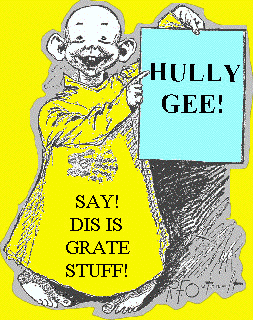
Very reminiscent of the Pulitzer/Hearst yellow period when shock, reality, violence were key parts of newspaper wars. (Check out the "yellow kid.")

And yet the very search for entertainment can be the vehicle for "serious" journalism when it leads to a scraping of the barrel for fresh stories and angles to rivet an audience. Still, fresh is sometimes hard to find when everyone chases the same story.


Journalism, of course, rarely strives for "perspective." It is a tool of its times, a creature of passions, a mobilizer of audiences for ratings, prestige, power, and profit.

It is a bully box for princes, charlatans, fools, for querulous complaining, a prime purveyor of popular populism, of triumphant nationalism. "On Team" and "Off Team."

A terrifier of the people, a mobilizer of the nation. Shaper and pawn of the times.....

Often smoothing those with power, yet digging up the dirt. Painting out the truth in lovely shades of yellow.

Lots of changes, lots of changes. Ah, the journalism of nationalism runs amok in an age of globalization.

At still other times -- just excruciatingly dull.


"Truth in Media:" very little change except the technology.

"What has been is what will be, and what has been done is what will be done; and there is nothing new under the sun."

Wednesday, July 26, 2006

A small Mideast war yields big lessons

I am struck by the gutsy, brilliance of Israel's brinkmanship policy.

Using a decisive and ruthless military strike, as did Deng Hsiaoping in February 1979, the Israelis have engaged their American patron's protective umbrella to teach a punishing lesson that Israel is no "paper tiger," that it will not be triffled with. If you rouse the dragon, do not expect a "proportional" response.

This proxy war between Iran and the US via Hezbollah and Israel is reminiscent of another proxy war a quarter of a century ago: between America (China's patron) and the Soviets (Vietnam's patron.).

The Chinese invasion of Vietnam opened a new chapter of the entrenched American Soviet Cold War going back to 1948. Israel's assault on Hezbollah in Lebanon opened a new chapter in the bitter American Iranian feud going back to 1979.

In multiple levels of conflict the name of the proxy game is to teach a lesson, to shift and cap a new balance of power. It can be a ruthless, brutal game played with the lives of others.

Yes, we all see the present through the lens of our past. Afterall I covered the brilliantly conceived Chinese invasion to teach Vietnam and the Soviets a lesson.

As back then, the US conditionally backs its proxy, provides a protective umbrella, vows to prevent Israel's other enemies from joining in, grants Israel, as earlier China, a finite period to wreak its damage, to tear down Washington's opponents.

Washington arms and supports its Israeli proxy to tear down, limit, teach a lesson to an "out of control," emboldened Hezbollah and to the Iran which encourages, finances, arms it.

This is a more transparent, but so far much smaller war than China's invasion of Vietnam where more than 20,000 died in 29 days of fighting.

We had President Carter's National Security Advisor Zbigniew Brzezinski then and President Bush's Secretary of State Condoleeza Rice now playing similar roles as power politics brinkmanship activists rather than peace seeking mediators. Each backed by a boss to be "shaped" a bit. Bush now, Carter then.

Ultimately Washington both protects its proxies and pressures them (once China, now Israel) to limit actions, to avoid getting in over their heads, to avoid provoking a wider war which would require even more direct American military involvement.

Just as Deng manipulated distant Washington to counter both the Soviet Union and Vietnam in his own neighborhood, Israel manipulates an eager Washington to be its "force magnifier" in the Middle East. Israel moves NOW while a sympathetic Bush is President.

Brezezinski (and Carter) hoped the Chinese invasion would make more costly the structure of Soviet expansion which armed and supplied a Vietnam proxy. Indeed President Reagan later took the cue to use proxies to counter Soviet influence in Indochina, Afghanistan, and Central America.

Brinkmanship, power politics.

Thursday, April 27, 2006

"Remember 9/11" - when fear goes on the attack

"The Best Defense is a Strong Offense."

That catchy phrase is so often used as a foundation for America's defense against terrorism.

To clean out the stables where violent schemes are hatched, to send American soldiers and bases abroad, to remake into peace loving American style democracies the autocratic societies where terrorism sprouts.

To transform the world into a reflection of American values.

Or, in the words of Woodrow Wilson, "to make the world safe for democracy."

FEAR of attack requires increased security and that requires increased power. Yet this growing power vigorously projected abroad increasingly makes America the target.

As the basing of US forces in Saudi Arabia following the Gulf war enraged Arab militants such as bin Laden. As American occupation of Iraq stirs the militant hunger for still more revenge against the United States.

More American FEAR completes the circle.

*************
So a FEARFUL "war on terror" morphs into a struggle to build American supremacy in the Middle East.

Taking on fundamentalist Iran, the one potentially nuclear armed power that can present an overt challenge to a US trapped in an Iraq crater of its own making.


Shakily entrenched in Iraq to Iran's west and Afghanistan to the east, the Americans intensify their containment of Iran by building ties with Iran's northern neighbor, Azerbaijan, once a part of the Soviet Union.

*************
FEAR. Listen to Columbia University international politics professor Robert Jervis:

"Fear is an enormous driver in international politics. Again, I go back to Thucydides, the cause of the Peloponesian Wars, the growth of Athenian power and the fear it created in others, what we call the security dilemma which is the way in which one country increases its power and makes others less secure. I think this isn't the root cause but it's one of the two or three root causes of international politics, and living in New York especially, you saw fear and what it did and what it does...

"You saw the Bush administration feel it in their gut, partly because there were all the stories about nuclear weapons planted in Washington. None of us knew this but I've heard enough now -- I don't know the sources, but they really did believe it. So, they felt the fear in their gut, and then I think they did manipulate it for their own purposes. International politics is a great home of fear."


*************
FEAR merges with many traditions of American expansion.

The greatest period of American expansion followed the World War II defeat of Germany and Japan. "Remember Pearl Harbor" was a slogan which tranlated into into a "never again" vigilance against a possible Soviet attack. Massive armaments, global alliances and farflung bases transformed the U.S. into the world's number one power after the collapse of the Soviet Union.

The political fault lines in debates on historic American expansionism go back to 1847 and 1898. The patterns are remarkably similar to today.

In the Mexican War of 1847 and the Spanish American War of 1898 American unilateralism challenged Europe's old order -- and asserted the right of American military power to shape important regions of the world.

Those two grand small wars pitted growing American power against yesterday's infidels, those seen to be barbaric remnants of Europe's Roman Catholicism.

*************
In those great national near religious debates New England was so frequently the cradle of the anti-war camp -- and the South, including Texas, the place where religious fundamentalism and
military tradition provide the great wellspring for military expansion.

Living in the South helps to understand how deeply rooted in America is the expansionist religious, military tradition. A truly sacred part of American life, a deep, deep color in American history.

Christian based American expansionism often takes on a barbaric dictator such as Saddam the "Butcher of Baghdad," or Weyler "the Butcher of Havana," or the great Mexican tyrant once supported by the Americans -- Santa Anna of Mexico.

Human rights and the spreading of democracy is often powerful rhetoric and belief, a gateway for expansionist war.

The Mexican American war, begun to help slavery survive, proved a democracy could fight an offensive battle deep into the heart of Mexico. It brought Texas, the Southwest and California into the United States, in a grand expression of "manifest destiny." It was democracy's first expansionist war, aside from campaigns to defeat Indians.

The Spanish American war, fought in part to liberate Cuba from Spanish atrocities, brought America empire into Cuba and the Philippines. Made the US a player in the Pacific. Opened the door to World War II by beginning a growing American rivalry with Japan.

*************
"Remember the Alamo," "Remember the Battleship Maine," "Remember Pearl Harbor," "Remember 9/11."

All were blood atrocities shrouded in murky dust, though their origins not always clear, which became the causa belli for the spreading of American power. When defense became a rationale for offense. The rallying cries for US military assaults on Mexico City, up San Juan Hill, through the streets of Baghdad.

War in Iraq: to weaken possible future sanctuaries for terrorists, strengthen an American military and oil presence in the Middle East -- and in its grandest expansionist dream to transform that area into the image of American Judeo-Christian democracy. And indirectly to strengthen the long arm of the American presence into the once forbidden underbelly of the former Soviet Union.

*************
The War Camp and the Peace Camp. When circumstances open the gate to war, these camps reemerge, always different, but with remarkable continuity.

Take the last presidential election: John Kerry, Brahmin New England elitist flies in sullied form the hi brow, poetic internationalist peace mongering flag of Margaret Fuller during the Mexican War. George Bush, rich diapered adopted son of the Texas frontier could be speaking the language of crushing Filipino insurrection after Americans took over that Spanish colony during the Spanish American War:

"We'll hunt em down ---- and civilize em with a Krag (rifle)"

Even the rhetoric shows remarkable parallels......

Onward Christian Soldiers, marching as to war.......

Spread the light of freedom to create a better world.

*************
Is this right or wrong?

Let's just say it's the flow of history, a familiar recurrent pattern as angry, fearful, awakened Judeo-Christian power clashes with a resurgent Islamic fundamentalism.

Different? Yes, but echoes all the same....Keep listening.

Wednesday, April 26, 2006

Shocking Iraq possibility: peace breaks out!


(Written in December 2002, during the run up to the March 2003 American led invasion of Iraq.)


*****************
The preconditions for peace are fairly simple. Indeed it is a shocking possibility that peace could be the road ahead.

Both Bush and Saddam have an escape door from war, if they choose to open it.

For much of the wrangling so far has concerned mass destruction weapons the US says were never destroyed by Iraq - but which Iraq claims to have destroyed by the mid 1990's.

*************************************
Yet the really compelling long term issues concern not so much any existing weapons but the possibility Saddam has the means and intent and the technical and scientific talent pool to produce more.

Fascinating as the current inspections and voluminous Iraq reports are, if one goes back to consult the public intelligence conclusions (CIA, British, and International Institute of Strategic Studies) much of this may be irrelevant.

What is striking is that ALL these intelligence estimates focus NOT on existing stocks of weapons, but the potential CAPACITY of Iraq to quickly produce chemical, biological, and nuclear weapons in the future, if Saddam wishes to. They all assume Saddam wishes to.

All are very VAGUE on anything already in existence. A major issue here is the ability to mobilize dual use facilities for FUTURE weapons production.

If peace to be preserved, some way will need to be opened to shape Saddam's intent, to watchdog and ensure that Iraq's capacity to produce future weapons does not actually produce those weapons.

*************************************
If a peaceful way is sought, it will be less important to account for every remaining piece of weaponry (thus proving Saddam a liar to be ousted) and more important to develop extensive inspection techniques to bar, to prevent future production.

If the US seeks war, it can easily find or manufacture a "causus belli" based around weapons alleged to be hidden from the past.

If the US seeks to avoid war, it will need to engage Iraq in the kind of long term extensive inspections which will be needed to bar weapons production in the future.

*************************************
If both sides decide war is unacceptable, they will find ways to finesse the issue of weapons remaining from earlier disarmament while focusing on a regimen of tight controls for the future.

Both Bush and Saddam will need macho opportunities to claim victory, to pose as powerful warriors.

For Bush it will be the media driven image of playing Teddy Roosevelt, of intimidating, bending, humiliating the "Butcher of Baghdad." For Saddam it would be the ability to emerge as an Arab hero --- facing down, resisting, surviving the Yankee colonialist.

*************************************
But peace will only break out if BOTH Iraq and the United States come to understand that the alternative could be "disastrous" for both sides: for Saddam his death will be certain; for the US a costly war which may undermine its economy and deprive George Bush of re-election.

*************************************
Bush must come to think (and fear) that invading and occupying Iraq will escalate the threat of terrorism, isolate the US globally, and risk large US casualties, including possibly from chemical and biological weapons... If war appears easy, affordable, safe, Bush will choose the path of military violence.

Saddam must see...a continued and deadly deployment of US forces that can be sustained over time. That this American presence ....will destroy him if he embarks on any further course of producing FUTURE weapons of mass destruction....He must see a tough long term American policy that does not turn "to go home" when a different President comes to power.

*************************************
Hanging over this is a major question mark.

Is it technically possible to monitor, to watchdog future Iraq weapons production? And if Iraq moves to produce mass destruction weapons in the future, how hard would it be to attack then?

If the Administration decides this is impossible, or impractical, it may decide to skip the shocking possibility of peace and to go to war "now."

*************************************
And make as its excuse an argument over missing weapons from the past.

(And so it came to pass.)

Saturday, April 15, 2006

A Jewish conspiracy? So far God isn't talking...

When it comes to Judas, everyone "spins" the story. Both then and now.

What really happened? So far God isn't talking.

But some people say they are "in the loop."

"I think I was chosen by Judas to rehabilitate him," Ms. Tchacos Nussberger, 65, is quoted as saying in one of the National Geographic Society's books, "The Lost Gospel," by Herbert Krosney. Mr. Krosney is also an independent television producer who brought the project to the Society.

Ms. Tchacos Nussberger, Jewish, was instrumental in making the Judas Gospel available for translation and publication by the National Geographic.

The freelance producer of the National Geographic special, is Herbert Krosney, Jewish, an experienced journalist who lives half the time in Jerusalem and half the time in New York.

The second century A.D. Church leader Irenaeus seems to have raised the blackening of Judas to the fore in the battle against Gnosticism, a mystical religious strain which sometimes raised disciple Judas as Christ's "chosen one."

The Gnostic Gospel of Judas was excluded from the Christian Church canon.

As centuries passed from the day of Irenaeus, an increasingly black portrayal of Judas, based on the four canonized gospels, had become a central symbolic representation of Anti-Semitism. Judas the Jew selling out Christ for 30 pieces of silver.

In European pograms and in the ghettoes of American cities Anti-Semitic gangs screamed "Judas, Jesus killers" at the Jews they chased, stoned, sometimes killed.

So is raising up a new Gnostic gospel text from the third or fourth century A.D. a Jewish conspiracy to alter Christian doctrine, to protect, and elevate Jews by elevating Judas?

Nothing so grandiose.

Still the agenda is hardly hidden: --- to make a "real splash" in undermining (or broadening, depending on your viewpoint!) traditional pillars of faith canonized in the Christian New Testament.

And by upgrading Judas create an alternate image that undermines one popular historic theological rationalization for Anti-Semitism. The Gospel of Judas maintains Jesus himself asked Judas to betray him -- as part of a broader plan for salvation.

Just the latest use of media to "altar" the way religion is used to view the world.

For mass media is now the secularly religious "altar" upon which doctrine and theology is placed for stimulation, curiosity, discussion, debate.

A battleground for competing faiths and doctrines -- as Jews join others who would reverse the early Church's exclusion of a mystical "heretical" doctrine from the accepted canons of Christian faith.

So the "new Judas" is now one of our latest media scoops. Recycling through dozens of media outlets with a breathless "now it can be told." In a ripple of publicity that has raised esoteric second century theological debates into a lucrative modern media extravaganza.

In our current mass media age theology clearly "rocks."

One other thing:

Almost two thousand years ago the nature of Judas was debated by the Church fathers --- and by all kinds of thoughtful folk in the the tents and caves of Palestine. Today it is argued in thousands of postings on the internet. Sample the discussion and debate in other internet blogs on this topic.

Which blog -- if any -- is God talking?

*********

There appears to be little new in the Geographic's resurrection of the Gospel of Judas, a text rediscovered a quarter of a century ago. View parts of the "lost gospel" translated and printed by the Geographic.

What is new is the way the issue is raised to prominence, and promoted for mass consumption in a world with a mass culture appetite already raised by the titillation of "heresy" --- ie. the massive popularity of the Dan Brown's Da Vinci Code.

The National Geographic has a large campaign promoting the Gospel of Judas, featuring it in two new books, a television documentary, an exhibition and the May issue of the National Geographic magazine. Judas appears to be the favored disciple, given special disclosures from Jesus himself.

Two of the nine member Advisory Board are American academic specialists on Gnosticism, with a personal and professional interest in promoting awareness of this early competitor to the established Christian Church.

In this new old gospel the language is mystical, abstract, full of angelic symbols and visions of a heaven and an underworld. There is the familiar style of Jewish and early Christian Biblical apocalypse. Yet the abstract mystical linguistic flavor vastly differs from all four canonized gospels, each of which tells a different version of the birth, life, and death of Jesus.

And so Judas emerges as a favored disciple, with unique insights into the future, gained from special "access" to teacher Jesus. Saith this gospel:

"Jesus answered and said,
'You will become the thirteenth, and you will be cursed by the other generations—and you will come to rule over them. In the last days they will curse your ascent to the holy generation.'”


Judas
Judas Gospel
Anti-Semitism
Irenaeus
National Geographic translation and publication
National Geographics Advisory Board
Christian Church canon
Parts of the Judas Gospel translated and printed by the National Geographic
Da Vinci Code
Thousands of internet blogs discussing and debating the Gospel of Judas