Thursday, February 23, 2006

Bush helps boost the power of fundamentalist Iran

President George W. Bush has opened the door for Iran to make a fresh grab for power in the Middle East.

That is one result of the Bush decision to overthrow Saddam Hussein and destroy his long-term hope to dominate the region.

The American led invasion has eliminated Saddam's "buffer" against neighboring Iran and opened a vacuum for growing Iranian power. An Iran pledged to eliminate Israel and seemingly on a path toward nuclear weapons.

The very same Iran which had tossed out the American-backed Shah, held US hostages in late 1979, and humbled the greatest power on earth.

Now that Iraq splinters into religious conflict and terrorism, the American occupation has taken over the task of holding together a "buffer" against Iran.

Of course the Bush Administration hopes to isolate, undermine, and overthrow Iranian fundamentalists with possible sanctions against development of Iranian nuclear power.

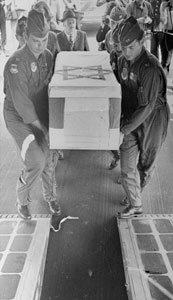
Only time will tell how much of a long term boost the Bush policy gives to the very same revived Shite militant fundamentalist Iran which President Reagan had built up Saddam to oppose -- way back during the Iran Iraq war of the 1980's. (See photo above)

Ironically some who pushed for the invasion of Iraq hoped the overthrow of Saddam would open the door for revived American power in the Middle East -- some 20 years after the Iranians threw the Americans out.

For background perspective on the drive for an American "comeback," see this writer's Human Rights Justifies a March Toward War.

It is anyone's guess what will happen if and when the Americans leave Iraq. Some like Barbara K. Bodine, coordinator for post-conflict reconstruction for Baghdad and the central region of Iraq in 2003, have argued American withdrawal might actually promote internal reconciliation in Iraq.

This writer explores the growing American bipartisan consensus for withdrawal in the blog Exploding the Iraq Illusion. For exhaustive collections of online texts, see Iraq Withdrawal and Exit Plans and Insurgent Iraq, both by the Project on Defense Alternatives.

For more immediate material on the rise of Iran, see the analysis in the Los Angeles Times, excerpts below:

******
2/18/06 Los Angeles Times
NEWS ANALYSIS
Iran Was on Edge; Now It's on Top
The war in Iraq has bolstered the regime's influence in the region and made it bolder.

By Megan K. Stack and Borzou Daragahi, Times Staff Writers

BAGHDAD — The Islamic government in neighboring Iran watched with trepidation in March 2003 when U.S.-led troops stormed Iraq to overthrow Saddam Hussein's regime and start remaking the political map of the Mideast.

In retrospect, the Islamic Republic could have celebrated: The war has left America's longtime nemesis with profound influence in the new Iraq and pushed it to the apex of power in the region.

Emboldened by its new status and shielded by deep oil reserves, Tehran is pressing ahead with its nuclear program, daring the international community to impose sanctions. Iran is a Shiite Muslim nation with an ethnic Persian majority, and the blossoming of its influence has fueled the ambitions of long-repressed Shiites throughout the Arab world.

At the same time, Tehran has tightened alliances with groups such as Hamas, which recently won Palestinian elections, and with governments in Damascus and Beijing.

In the 1980s, Iran spent eight years and thousands of lives waging a war to overthrow Hussein, whose regime buffered the Sunni Muslim-dominated Arab world from Iran. But in the end, it took the U.S.-led invasion to topple Iraq's dictator and allow Iranian influence to spread through a chaotic, battle-torn country.

Now Iraq's fledgling democracy has placed power in the hands of the nation's Shiite majority and its Kurdish allies, many of whom lived as exiles in Iran and maintain strong religious, cultural and linguistic ties to it.

Wednesday, February 08, 2006

I'm too much of a Coward: Go see for Yourselves


What a friend wrote to me......
"It's OK to burn the American Flag, to preach 'destroy Israel,' --- but not to publish cartoons offensive to Muslims. What am I missing? "

*******

Yes, what are we missing in discussing whether freedom of the press includes the freedom to run cartoons offensive to a religious or ethnic group?

And who decides what is offensive? Who decides when wisdom demands retraint rather than provocative polemic? Should we trim our sails when angry protestors get violent -- or reassert our freedoms to avoid intimidation?

We all sometimes thrive on double standards.

Some in the Middle East offended by cartoon satires on Islam have now proclaimed their right to intervene and censor the culture and media management of Europe and the United States. Perhaps that is only fair given the West's many interventions in the lives and cultures of the Mideast.

In the end our own excesses can be our greatest enemies.

"Insensitive" Danish cartoons satirizing the prophet Mohammed were a gift to radical Islamic agitators, who could use them to mobilize mobs, grab headlines, to intimidate corporations, media, educational institutions, and governments.

Burnings of American flags during the Vietnam war were sometimes a gift to patriotic extremists who could rally popular support by casting anti-war activists as traitors stabbing American soldiers in the back.

Like the cartoonist, we all can hand our "enemies" a weapon to club us with when we behave provocatively without wisdom or balance.

Then our enemies can go on to "shoot themselves in the foot" when they respond with foolish intimidation and violence which reinforces negative stereotypes of them. Which appears to confirm the negative image of Islam in the cartoons.

We can all benefit from the excesses of our enemies.

***********

This blogger himself had to make the decision: should he post the offending cartoons here? Should he omit them out of intimidation and/or a sense of wisdom or taste? And what would the host server of this blog do if this blogger posted the offending cartoons?

So let me be both wise and cowardly and simply steer you to a web address where you can see the offending cartoons for yourself.

Gentle Reader, you definitely need to see these cartoons to fully understand what has triggered the reaction. You must see them to understand the sensibilities of the offended. How nice that the web gives me the opportunity to cowardly censor my own copy -- yet give you the opportunity to "see for yourselves."

So visit this site and see for yourself.

http://www.humaneventsonline.com/sarticle.php?id=12146

Yes, every person can pose as a victim of some offense. We can all do battle to preserve or grow our turf -- and let our own sensitivities fuel our hunger to put down our real or imagined enemies.

In the end we all share something in common: our own excesses can be our greatest enemies.

Tuesday, January 17, 2006

"Red Diaper" goes "Red, White, and Blue"

Take the moral anguish over the use of force in Jewish filmaker Steven Spielberg's movie "Munich."

Contrast that with the muscularly military conservativism of the Jewish "neoconservative" intellectuals and policy makers who helped plan the invasion of Iraq.

This tension is not new.

This writer witnessed it as a graduate student during the "Free Speech Movement" at the University of California, Berkeley more than 40 years ago.

On the one side, along with many who were not Jewish, radical Jewish students and their sometimes youngish professors. On the other a handful of older conservative Jewish scholars, often left in their youth, who turned from diatribe against American culture and capitalism in the 1930's to diatribe against student radicals in the 1960's. One example: sociologist Lewis Feuer.

Back then the left (or "New Left") prevailed -- more critical of anti-communism than of communism, traumatized by the anti-Semitic overtones of McCarthyism. Denouncing American power as imperialism, spurred on by opposition to the Vietnam war and by an alliance with the Civil Rights movement.

In the liberal-radical tradition of Jewish Americana there sometimes seemed a defensive, reflexive "anti-Americanism" critical of gentile values, seeing patriotism as a disguise for anti-Semitism -- sometimes even mocking the American flag. A tendency to apologize for the Soviet Union while criticizing the United States.

It was a tradition which sometimes sought protection from gentile American culture by hiding in the cocoon of abstract European Jewish Marxist thought. A few even spied for the Soviet Union. Apologetics for Stalin in the battle against facism produced a generation of "red diaper babies."

Back then a keen awareness of barriers against Jews in MANY areas of American life. Yet a hungry quest for upward mobility, for respectability and wealth and power in America's law, medicine, cities, suburbs, schools, universities, government and corporations.

******

Forty years later a different form of conservative Jewish thought has emerged in the halls of the White House, in the Pentagon and in countless streams of media.

This includes the "neocons" who helped engineer the Iraq war, after first emerging into public prominence in the Reagan era.

Deeply committed to American cultural, and capitalist power. Seeing now dead Soviet power as anti-Semitic rather than as an ideological beacon for international progress.

This tradition repudiates the "anti anti-communism" of "its youth" and favors global American military dominance as a bulwark against anti-Semitic Arab theocratic totalitarianism, as protection for both American interests and for Israel. While the radical Jewish tradition decries American "imperialism," the "neocons" cry out for an American imperial role as a global saviour.

Like the old style left, Jewish conservatives often see the world as a Manichean struggle between good and evil.

But a difference -- for in this time there is keen awareness that Jews thrive in almost ALL fields of American life. Yet still a hungry quest for respectability, for upward mobility and wealth and power in America's law, medicine, cities, suburbs, schools, universities, government and corporations.

______
Peter Haas, The Future of Jewish Liberalism
Michael E. Staub, Torn at the Roots: The Crisis of Jewish Liberalism
Irving Kristol, Neo-conservatism: The Autobiography of an Idea
Murray Friedman, The Neoconservative Revolution
John Earl Haynes and Harvey Klehr Venona: Decoding Soviet Espionage in America
Allen Weinstein and Alexander Vassiliev
The Haunted Wood
National Security Agency (NSA) The Venona Story

Saturday, January 14, 2006

A moral price to pay? Leave anguish for a later day

Controversy over Steven Spielberg's film Munich?

Most Certainly!!!

For this is a film which dramatizes issues in today's war on terrorism -- as much as it reflects controversy over Israel's secret campaign of assassinations against terrorists held responsible for killing 11 of its athletes in Munich in 1972.

The purpose was not only revenge, to let the world know that there would be a price to be paid for the killing of Israelis -- but also to create a climate of "counter-terror." The aim: that any persons who dared plan terror against Israelis would think twice -- knowimg they might be marked for death. In short, both revenge and deterrence.

Pro Israel zealots such as Charles Krauthammer have sometimes eloquently denounced "Munich" as a film of moral equivalence which puts Israel's efforts at self defense in the same basket as ruthless Arab terrorists who systematically kill civilians to annihilate Israel.

The film clearly "humanizes" the targets of the Israeli assassins. But the charge of moral equivalence makes no sense. Spielberg tells the story from an Israeli point of view and focuses always on Israeli issues and values.

Spielberg gives to Israelis a higher sense of conscience, focusing frequently on how far Jewish assassins went to avoid harming "innocents." He also portrays several Israeli terrorists as plagued by concerns their revenge killing might compromise historic Jewish values. All this clearly puts Israeli fighters on higher moral ground than terrorists who deliberately target civilians.

Central, if subliminal to the movie, is the controversy over George Bush's willingness to adopt Israeli tactics.

At the heart of the Bush approach are both preemptive and retaliatory actions to hunt down suspected terrorists, to kill them with gunfire, bombs or rockets -- or secretly kidnap and imprison them, where they may face torture.

The Bush approach is in part a campaign of "counter-terror" aimed at deterrence. The message to be sent: anyone who picks up the terrorist cause against Americans may pay the ultimate price.

The US has not fully adopted Israeli tactics, but has gone a far way down that road. The President still is subject to congressional and court challenges over just how far he can go. And over whether his actions are compatible with the constitution or with American committments to international law.

******

So where does the movie "Munich" leave us?

Fighting back may be necessary -- but "counter-terror" can be costly not only to our enemies but to our moral sensibilities. That is IF we CHOOSE to be anguished when we inflict death and suffering.

There are no free lunches in wars where murder is a tool of state. Even when human beings we kill are not "innocent," they are still human beings.

As someone puts it in the movie: "for every civilization there is a time when it may have to compromise its own values."

There is, of course, little sign the Bush Administration shows anguish.

There is plenty of anguish in Spielberg's "Munich." Still, the challenge for every generation is to "get on with it," to do the killing as quickly and as efficiently as possible so that the values of peace can be restored.

Even when a cause seems righteous, there is a cost. In today's world, as in the past, a moral price must be paid.

Leave anguish for a later day.

*****************
See:
"The Munich Syndrome," Weekly Standard
"War on 'Munich,'" Spiegel
Charles Krauthammer, "Terrorists Win in 'Munich,'" Real Clear Politics
George Jonas, Vengeance (book on which the movie is based)
"An Action Film About the Need to Talk," The New York Times
Spielberg calls his film "a prayer for peace" (BBC)
Spielberg hires a key Sharon aide to promote his film (BBC)

Wednesday, January 11, 2006

A Nation Blogs Hugh Thompson, Jr. - Departed Hero

More than 3000 blog entries have been posted since the January 6 passing of Hugh Thompson, Jr., the military helicopter pilot who landed his bird in the midst of the March 1968 "My Lai Massacre." He is credited with helping to stop the killing.

The blogs are from Left, Right, Center. They show a national grassroots outpouring over the death of little known 62 year old Thompson. The new blog technology allows a national ceremony of grief and admiration for a man rarely honored in the mainstream media.

For a partial listing of these blogs see Hugh Thompson, Jr.: Blogging on a Hero. (Image above from Culture of Life Breaking News Blog).

The blogs celebrate in a new technology something philosophers and theologians, movies and novels have been honoring from ancient beginnings -- appreciation for those special individuals who answer the call of the moment to risk all -- to do what must be done -- whatever the cost.

Thompson ordered his gunners to shoot American soldiers if the killing of civilians continued. G.I.'s had ran "amuck" to kill more than 500 Vietnamese civilians in the hamlet known as "Pinkville" -- herding them into ditches, raping and shooting young women in what was later described as "a Nazi kind of thing."

Few, if any, shots had been fired that morning at American forces. But the destruction at My Lai was carried out by stressed, poorly led soldiers who had suffered numerous sniper and booby trap attacks -- and viewed civilians in the village as part of the communist war effort.

Here is a more detailed account of what happened.

A 1989 "Frontline" PBS documentary hosted by Judy Woodruff moved Thompson into the spotlight. A gripping on camera interview with the sometimes weeping ex soldier relived the moments when he moved into action. One result was lobbying to get official recognition for his deeds

Thompson's story touched many of us in different ways.

I taught a unit on media and My Lai at University of Rhode Island -- showing the "Frontline" documentary to a class of 300 as part of a case study of how a scandal seeps into the mainstream press after military whistle blowers force an internal investigation. Freelancer Hersh had seized upon the story to create a national scandal which helped force the United States out of Vietnam.

The "Frontline Documentary" helped inspire my research and writing for the website "American Human Rights Reporting as a Global Watchdog."

Thompson's life moved on in obscurity while the anti-establishment whistle blowing journalist Seymour Hersh moved on to fame. Only in the 1990's did the story get fuller play when Thompson finally received military honors.

Wednesday, January 04, 2006

American Apartheid: the "Blue State" Blues

There is an irony in this land.

The "Blue States" of America, whose voters often adhere to liberal "favor the underclass" values, all too often close their doors to all but the wealthy. They often segregate the underclass in black urban ghettos or distant white "bantustans" reachable only by long highway commute.

Indeed for those not wealthy, life is often preferable in the "Red States," dominated by traditional conservatism, with relatively little ideological lip service to the underdog. Jobs may not pay as much, there may be plenty of poverty, but the basics of life can be purchased by the less well heeled, even sometimes by the poor.

Take a most extreme "Blue State" case, that bastion of "economic apartheid:" the highly "liberal" San Francisco Bay area.

In northern California houses routinely sell for more than one million dollars, even in the distant regional environs miles from San Francisco. An additional bedroom or bath may add more than one hundred thousand to the price.

Minimum wage minorities may have public housing and subsidized public services in urban ghettos. Students and other youth may bundle up in shared rooms or houses.

Working class non minorities may commute in by car one hundred miles or more. Huge sections of northern California "bar" new immigrants -- unless they are wealthy. The one exception is illegal immigrants from Mexico who are actively recruited into menial jobs while living in crowded low cost rooming houses or apartments -- with no need to commute the vast highway distances which a low income American citizen might need to travel.

The danger is that in milder form the San Francisco phenomenon is spreading: that "economic apartheid" can spread as Blue Staters help establish in Red States the "economic apartheid" they left behind.

As Blue State retirees migrate to retire into Red States with their lower prices and sometimes milder climates, they drive up Red State prices by using the nest eggs they gain from from selling their Blue State houses to buy and drive up the prices of Red State houses.

And that raises the cost of living for Red State folks, "stuck" as they often are on lower Red State wages.

Of course "Economic Apartheid" is nothing new. The songwriter Woody Guthrie picked it up in the 1930's when he wrote of California:


You want to buy you a home or a farm, that can't deal nobody harm, Or take your vacation by the mountains or sea. Don't swap your old cow for a car, you better stay right where you are, Better take this little tip from me.

'Cause I look through the want ads every day But the headlines on the papers always say: If you ain't got the do re mi, boys, you ain't got the do re mi, Why, you better go back to beautiful Texas, Oklahoma, Kansas, Georgia, Tennessee.

California is a garden of Eden, a paradise to live in or see;
But believe it or not, you won't find it so hot
If you ain't got the do re mi.

Wednesday, December 14, 2005

President Bush: An Honest Mistake?

It sure seemed strange.

There was President George Bush citing the number of Iraqi civilian dead as about 30,000.

At a December 12 question and answer session at the World Affairs Council of Philadelphia Bush used the figure put out by a strongly anti-war British based group, which publishes on the web Iraq Body Count.

Since when does the President publicly adopt as reliable the numbers put out by a sometimes controversial anti-war civilian watchdog?

When official American sources say they cannot estimate or give out civilian body counts, when official policy obscures these deaths in order not to undercut support for war.

Is such Presidential "openness" just an "honest mistake?"

Interesting to speculate on how Bush came to rely on Iraq Body Count figures -- which, after his comments, were qualified by official sources.

The figures President Bush used come from a pre-emptive human rights watchdog put in action before the launching of a pre-emptive war. This is, no doubt, the first time in history a civilian group other than the Red Cross was set up a civilian casualty monitoring system BEFORE a war began.

Iraq Body Count uses in modified form a media monitoring technique developed by Marc Herold, a strongly anti-war professor from the University of New Hampshire. He opposed and monitored the Afghanistan war at a time many American media were reluctant to report civilian casualties there for fear of appearing unpatriotic. (The press of other nations reported civilian casualties). Herold, whose reports on Iraq were challenged by some as exaggerating civilian deaths, was an advisor to Iraq Body Count when it was set up before the American invasion of Iraq.

Iraq Body Count provides a "button icon" which any web designer can place on a web page. Whenever the page is opened any place in the world, it reproduces the icon with the latest automatically updated casualties figures displayed. It's tone is more restrained than Herold's work on Afghanistan.

For more on American and other media coverage of civilian casualties and on Iraq Body Count's automatically updating internet button, see this writer's web essay "Civilian Deaths: Afghan and Iraq Wars " researched during both the Afghan and Iraq wars.

Iraq Body Count's automatically updating "button" is found in that essay. The writer corresponded with both Prof. Herold and Iraq Body Count staff in the course of his research.

Tuesday, December 13, 2005

Plunging Onward Out Ahead!

"All I could do was to scoop out a hollow in the sand."

"It worked. I'm here," said the 84 year old Marine veteran of amphibious assaults on Iwo Jima, Guam, and Guadalcanal.

Plunging Onward Out Ahead.

"I'm the World War II generation," he continued in the locker room of New Bern's Courts Plus gym.

Born in '22, he now was slow, so slow, as he crouched in the corner laboriously pulling on his trousers.

Slowly...slowly...slowly.....Yet once engaged in conversation, his story flowed out like a mountain stream.

Plunging onward out ahead...

"Were you the famous Marine photographed raising the victory flag over Iwo Jima?" I asked him with a chuckle.

"No, I'm the one who ran for cover," came a swift, twinkling reply.

"There was no cover, " he continued. No trenches could be dug into the beach soil. "All I could do was scoop out a hollow in the sand."

Then came the shrapnel -- in his chin through the lips, and right above the brow. "I pulled the shrapnel out, stuck on the bandaids, plunged onward out ahead."

Later, at Guam, came more serious wounds.

"Burns," he said. All over the face, shoulders and chest. When a Japanese suicide plane crashed a bit too close. For months he recovered in military hospitals -- fortunately, he recalled, penicillin had just become available, so antibiotic coated water wetted bandages made of toilet paper could keep infection at bay.

"You know now I'm loosing weight but my stomach keeps getting bigger especially when I sit...I used to do three sets of racketball every lunch hour....Now I'm down to swimming, but that gets hard with water in the ears...Today I just did a steam bath..."

"You're 64?" he said to me. "A young one.....you're doing the right thing to exercise. That will help keep you alive."

"Chiao," said the man from Iwo Jima, as he trudged just a bit woundedly out through the locker room door.......

Yes, it worked. He is still here.

Plunging onward out ahead.

Friday, December 02, 2005

"Gavin Plan:" What future in Iraq?

With a media blitz Bill Clinton moves to shore up Hillary's unfolding bid to become a presidential contender.

As usual, he stakes out a centrist position, breaking with his party's left, especially on Iraq. As does Hillary, he breaks with some Democrats' calls for quick Iraq withdrawal.

Instead he swings to qualified support for the emerging Bush doctrine, picking up on Bush's victory speech and the 35 page document outlining American strategy for victory in Iraq.

That strategy echoes in my ears -- for it is an agressive "let's win" version of the "Gavin Enclave Plan" advocated for Vietnam way back in the mid Sixties by famed World War II paratroop general James M. Gavin. He became an early critic of the Vietnam war, broke with government doctrine and retired early.

Gavin's view was that to win in Vietnam required escalation and war with China. Instead the US should withdraw to strategic enclaves, scale down fighting, then, if possible, negotiate. The Gavin plan was rejected (see below) for fear it would conceed the bulk of South Vietnam to communist rule.

Today's Clinton doctrine is an aggressive Gavin plan retooled "to win" -- whereas the original Gavin plan (see below) was rejected for fear it would NOT win.

Under the emerging Clinton version of the Gavin plan, the US would gradually withdraw to non-urban Iraq areas, reduce its occupying "footprint," bring home some troops, and thus reduce US casualties. It would hopefully reduce anti-Americanism in Iraq -- but allow U.S. forces to sally forth in agressive raids from American bases targetted especially at Al Qaeda -- thus allowing for a long term, less costly American presence.

(Yet since this was written, this doctrine for gradual withdrawal lies under a dark cloud, rejected by Bush, it would seem. For increasing sectarian violence means such an approach could lead to growing chaos. Indeed the Administration is beefing up deployments in Bagdad and elsewhere, putting off plans for withdrawal and keeping longer in combat troops who were slated for a return home, June 2007)

The plan would back up the new Iraq government with its weak police and military -- while retaining American public support for a long term presence in Iraq. All with a minimum of American casualties.

Of course Gavin saw his plan as a way out of an unwinnable war, while the Bush/ Clinton approach is aimed at a prolonged presence with disagreements on how to do it.

To maintain America's influence in Iraq, to block Iran, protect Israel -- and keep American troops close enough to strike at any growing terrorist bases in Iraq. Thus to keep Iraq from becoming the kind of terrorist sanctuary that Taliban ruled Afghanistan was for Al Qaeda.

The Clinton agenda is, of course, to smooth Hillary's path, to let her seem tough, but advocating policies which will reduce American casualties.

****************
On the Johnson Administration's rejection of the Gavin Plan, see:

Foreign Relations, 1964-1968, Volume V, Vietnam 1967
Released by the Office of the Historian
Documents 374-387


The Wise Men's Meeting of November 1 and Planning To Stay the Course, November-December, 1967

II. Possible Alternative Courses of Action

George Ball said that no one in the group thinks we should get out of Vietnam, and no one gives propriety to the Gavin or Galbraith enclave theory

James Gavin, a former General and Ambassador, advocated the enclave theory of withdrawing to fortified areas, most notably during hearings before the Senate Foreign Relations Committee in February 1966. Former Ambassador John K. Galbraith's similar plan was made public in late June 1967.

****************
On the famous paratrooper himself, see James Gavin:

The postwar military was not kind to Maj Gen James Gavin. He became the strategic planner for the postwar Army. While at home on the battlefield, he was not comfortable in Pentagon politics. His differences with top Army leadership ultimately led to his decision to retire.

Gavin continued to be influential in civilian life. He became chairman of the board of Arthur D. Little Company, advisor to President John F. Kennedy, and United States ambassador to France under the Kennedy administration.

"Born in 1907, James Gavin was the son of an unwed Irish immigrant. He was placed in a New York City orphanage at the age of one or two. He was eventually adopted by Martin and Mary Gavin, a Pennsylvania coal-mining family. His youth taught him the discipline and hard work that would pay dividends throughout his life. He enlisted in the US Army at age 17. Showing promise, he was selected for admittance to West Point."

"Gen. Gavin came to be known as the "jumping general" because he parachuted with combat troops during World War II. ...While a paratrooper, he led assaults on Sicily and on Salerno Bay, Italy, in 1943, reaching the rank of brigadier general, and jumped with the parachute assault section of the division on the first night of the Normandy Invasion (June 5-6, 1944). Elements of Gavin's section took the town of Sainte-Mère-Église and guarded river crossings on the flank of the Utah Beach landing area. Gavin was later made major general at age 37, the youngest major general since Gen. George Armstrong Custer. He commanded the 82nd Airborne during operations in The Netherlands and his division later fought in Germany until the German army surrendered in 1945."

Gen. James Gavin died in 1990.

Friday, July 29, 2005

To Come Home Aged but Ageless

A child cries out "'grandpa" and reaches out to touch a seasoned man he has only for the first time met.

Is this some ancient gene of automatic recognition with an automatic hunger for a seasoned face distant in years but close in kinship?

Then sing, sing, sing an ancient lullaby deep from a grandpa's youth. Maybe "All the Pretty Little Horses."

Stroke the child's hair. Watch relaxation cover the sleepy face. A timeless ritual softens the cry and eases him to sleep.

What's It All About?

The feeling that one has made a difference.
That there is something of you that will continue after you're gone.
That the fact that you have lived has in some way changed the world.
To touch a child....especially if that child is part of you.
To calm that child with stroking and a song.

These special moments transcend all hardships, all roadblocks which make rough the highway of life.

Reaffirmed is the world's natural order.

To hold and look upon the youngest is to come home aged but ageless.

In this instant moment of recognition, "The Circle is Unbroken."

Age, it has no meaning -- as the river flows on....

Wednesday, July 06, 2005

When Journalists Become Monkeys in the Jungle

Ah yes, Judith Miller of The New York Times goes to jail for refusing to divulge her anonymous sources.

Surely that symbolizes the moral cloud under which journalists now operate.

When reporters "defy the law," they may cite high principle. But beneath it all can be narrow self interest, or hunger to preserve professional standing by maintaining the ability to be trusted by future sources who may seek a reporter as a safe mouthpiece. How easy it may seem to hide behind the confidentiality of being a reporter's anonymous source!

As important as confidentiality of sources can be, we now have a situation where anonymous sources are as much a part of the problem as of the solution.

Beware anonymous sources.

Too often a scoop is a trap in disquise laid by an anonymous dagger carrying assassin whose motives have nothing to do with public interest or freedom of the press.

When hungry journalists race through the jungle eager to harvest any piece of fruit devious monkeys toss their way, it is the journalists who can end up as monkeys.

It is not at all clear that today's Judith Millers protect "whistleblowers." Indeed they may be in the service of ruthless "spin doctors" who seek to hide behind journalistic skirts to manipulate politics and public opinion for partisan political purposes.

Far better to focus on the important issues: do not allow oneself to be used!!!!! Keep the big picture in mind --- and do not be seduced by the promise of an "easy" scoop.

The still unproven assertion is that someone close to the Bush Administration was an anonymous source trying to convince reporters such as Judith Miller to unmask Valerie Plame as a undercover CIA operative. Although Judith Miller did not use what an anonymous source may have told her to "out" Plame, conservative commentator Robert Novak did. Ironically no one has at least publicly threatened to put him in jail!

What is at stake? The scuttlebut is that someone wanted to damage Plame's career, to get revenge on her husband, former Ambassador to Iraq Joseph Wilson, an outspoken critic of Bush plans to invade Iraq.

That Time Magazine parted company with Miller to gave up the court sought documents partly so that its reporter could stay out of jail further darkens the brew. If it seems a bit like professional aggrandizement for Miller to hold back, It seems a bit like corporate expediency for Time to give in.

Oddly Judith Miller, brilliant, accomplished though she is as a preeminent Times expert on terrorism, also is the reporter accused by anti-war critics of helping open the door to invade Iraq.

Her critics say passed on too uncritically the scare mongering anti-Saddam spin on weapons of mass destruction peddled to both press and government by partisans of Iraqi expatriate Ahmed Chalabi. Miller and others passed on the "spin" partly based on tips by anonymous sources.

Chalabi is a controversial figure for many reasons. In the lead-up to the 2003 invasion of Iraq, under his guidance, a major portion of the information on which U.S. Intelligence based its condemnation of Saddam Hussein, including reports of weapons of mass destruction and alleged ties to al-Qaeda, filtered its way to the U.S. government and into the U.S. media.

Much of this information has turned out to be false. That is one reason for a recent falling out between Chalabi and the Bush Administration.

So some see Miller not simply as a champion of freedom of the press but as a symbol of just how much a journalist can be corrupted by anonymous sources with hidden agendas.

Miller published nothing about Valerie Plame. Still, she appears to have allowed herself to be excessively manipulated by anonymous sources -- in what appears to be a failure of journalism accuracy and credibility.

So it comes to pass that on occasion a reporter's principles can also be a tool aiding misinformation and corruption -- for an anonymous source can have a license to irresponsibly spin!!!!!!

When Journalism Does its Job

It can be the privilege of a journalist and foreign correspondent to work for years with courageous people who endure much hardship to take on almost impossible odds, to do what must be done, to do what advances understanding and tolerance, to do what expands compassion, to do what rouses to action, to do what helps heal.

Tuesday, July 05, 2005

When a Hero Becomes an Embarassment

The movie Motorcycle Diaries could be taken many ways. Here is my take on this monumental man who ended his days as revolutionary martyr, an icon to Castro's failed global ambitions, a guerrilla revolutionary hunted unto death.

Guevara, the doctor child of priviledge came from the developed Europeanized side of southern Latin America, the Argentine, ventured north into the Chiliean, both lands of German immigration. the developed lands to the south of South America.

The more Europeanized Argentina from which Che came (as well as more Europeanized Chile) were later to be wracked by the brutal disappearances, Pinochet and all the rest, fascist style generals overturning their countrys' constitutions, cracking down on Marxism, partly in fear of Castro's influence. In both "civiliized" Chile and the Argentine almost "European style" fascist generals led inquisitions into the Left.

But that was twenty years later.

And as Guevara biked North in the early 50's , he biked deep from remnant Europe deep into the Third Word, leaving European "civilization" beyond, into the world of Indian mountain tribalism, dominated by Spanish elites, Peru and neighboring Bolivia, the area where banditry, rebellion, drug growing were to become the symptom of the incomplete subjugation of the highland, non-coastal Indian who once held such dominance in some of the world's greatest civilization. The Leper is a symbol of third world backwardness, treated, isolated in ambivalence by priests, doctors and nuns. While the big employers who sometimes exploited the Indians could often be from American corporate giants -- or American investment, ie Anaconda Copper.

It was in this "biking north into the Third World" which lay the origins of Guevaras's programs for global third world rebellion.

In uneasy alliance with Castro, he led the Cuban expeditionary forces in the far flung adventures both in northern Latin America and fighting the South Africans in Anglola Africa. This was the period when Castro sought to become a global power by providing Cuban soldiers in Soviet supported expeditionary campaigns.

Ultimately the Americans stepped up the pressure on Castro (and the Soviet Union) ---- and told him if you want to survive, distance yourself from Che and Che's activist support of Soviet supported "wars of liberation."

Under some accounts Castro did exactly that. And Che left for one last revolutionary foray into the Bolivian highlands -- to be hunted down by Bolivian commandos aided or led by the CIA.

With Guevara's passing, Castro had a revolutionary martyr to honor, but no longer the living irritant with America. Castro had now diassociated himself from a grand dream to lead a third world insurrection from the Americas to Africa. Oh, yes, he continued to defy America, but he had pulled in his horns a bit.

And so it came to pass that Guevara died, lived on a living legend, brought alive once again by Motorcycle Diaries.

No he was not the revolutionary Trotsky, ice picked by Stalin. But like Trotsky he became an embarassmnent to the real politik of the world. He, too, would be hunted down. His icepick, too, would come.

Tuesday, May 10, 2005

Dance of the Titans


It is most interesting that even as Bush and Putin dally with common ground, in front of Red Square, they each revert to traditional nationalisms:

Putin the theme of Russian/Soviet nationalism circling in the wagons to prevent Western penetration of Russian interests in Eastern Europe and along the Russian underbelly of Latvia, Gerogia, even Iran -- and Bush the denunciation of Yalta, the espousal of expanding liberty with the assertion of liberating American power right up around Russia's borders.

The legacies of two great, often expanding continental empires: one recently bled to disintegration -- and the other still in military expansion mode as it fights what it sees as massive potential threats to its survival.

Both may be caught in the past -- as new nations, and new global economies emerge.

Internal dysfunction can be the enemy of empire.

Tuesday, December 14, 2004

Book of Moritz: God's Plan

In going through my files I discovered something written by my fertile crescent ancesters centuries ago. This, it was revealed to them, was God's plan:

Book of Moritz, IXX, 1-22)

**********
To create men, to challenge and try women
To become ever more perfect while
dealing with the inadequacies of men.

To create man as a thorn in woman's side
to keep her humble, free from excessive arrogance,
remind her she is always below the gods,
as she struggles with the hurt inflicted by men.
Healing hurt with sacred lust.

To create women, to challenge and try men
To become ever more perfect while
dealing with the inadequacies of women.

To create women as a thorn in man's side
to keep him humble, free from excessive arrogance,
remind him he always below the gods,
as he struggles with the hurt inflicted by women.
Healing hurt with sacred lust.

Victims' Rights in the South

After months of reading how Europe is ahead of the States on many social policy issues, it is rewarding to find an area where the US is definitely ahead!!!!!

Here in the South, the message is pretty clear: if a burglar enters an occupied house he/she has a pretty good chance of dying.

In the US there is a real, though imperfect, recognition of victims' rights.

From the BBC:

@@@@@@@@@@@@@@@@@@@@@@@

People should be entitled to use any force necessary to defend themselves against burglars, England's most senior police officer has said.

Met commissioner Sir John Stevens said householders should be presumed to have acted legally, even if a burglar dies, unless there is contrary evidence.

Laws which often seemed to favour criminals should be clarified, he said.

People should be prosecuted only when there was evidence of gratuitous violence, he told the Daily Telegraph.

I'm not talking about guns but people being allowed to defend themselves

Under the current law, people are entitled to use "reasonable force" to defend themselves and their homes.

It is up to judges and juries to decide what level of force is "reasonable".

Sir John said the public and police were confused about what that meant.

The law was currently sending the wrong message by encouraging burglars to break into houses in the belief that no householder could harm them, he said.

He told the paper: "My own view is that people should be allowed to use what force is necessary and they should be allowed to do so without any risk of prosecution.

"I'm not talking about guns but people being allowed to defend themselves and use whatever is necessary to defend themselves against someone who may well be armed with a knife."

He said the current legal test of "reasonable force" was too imprecise for people to consider in extreme circumstances.

Sir John was speaking five days after City financier John Monckton was stabbed to death by an intruder during an attempted robbery at his home in Chelsea, west London.

In October, school teacher Robert Symons was killed in his home in nearby Chiswick.

"Now is the time, specifically with these two cases we have had recently...for the law to be clarified," he said.

He said the case of Tony Martin, the Norfolk farmer jailed for shooting dead a burglar in 1999, had distorted the self-defence issue.


"[He] did shoot the burglar as he was running away. He did use a gun that was illegal.

Sir John's comments were welcomed by supporter of Mr Martin, Malcolm Starr, who recently encountered a burglar at his own home.

"Unless you face a situation like this you wouldn't know what you would do at the time," he said.


"I would have liked to have killed the burglar. The hatred for him being there, and attacking my wife was so great."

John Cooper, a leading criminal barrister and representative of the Bar Council, told the BBC the current law means "it is all down to 12 people on a jury deciding on the facts what is reasonable".

He said many lawyers shared his view that this works well.

A law change could lead to more confusion and cause problems, he said, such as would a house guest who also attacks a burglar have the same "burden of proof" as the homeowner?

He said "month in month out," the Crown Prosecution Service dealt with cases where a burglar was injured but the case not brought to court.

Barrister and shadow attorney general Dominic Grieve, agreed with Sir John.

He said although householders who injure a burglar may not eventually be prosecuted they often faced "months of trauma" while a case was decided.

He said Tories were looking at legislation offering greater protection to householders.

A spokesman for the Home Office said: "Under the law at present people are perfectly entitled to use reasonable force to protect themselves, their property or their family.

"What the law does not permit is an act of retaliation."

Home Secretary David Blunkett announced a major review of the law on murder in October, saying many people had called for clarification on issues such as provocation and self-defence as it relates to murder and manslaughter.

Order and Chaos: Dover Beach

Yes, thanks, so Tolstoy's War and Peace deals with the tension between plans and chaos in war. I never really read the whole War and Peace. maybe it is my time.

I am surprised at my interest in all this. It is perhaps the residue of my own career, where I sometimes looked face to face into uncertainty, chaos, unpredictability, the dark side of people determined to kill. It is the responsibility of the journalist to bring temporary, sometimes misleading order out of chaos. So much of "our" intellectual and emotional and even professonal life can be an attempt to bring order, predictability, coherent understanding to things which are inherently unknown, unpredictable, beyond our grasp.

Matthew Arnold caught it well.

Fred

Matthew Arnold, Dover Beach, 1867

The sea is calm to-night.
The tide is full, the moon lies fair
Upon the straits; on the French coast the light
Gleams and is gone; the cliffs of England stand;
Glimmering and vast, out in the tranquil bay.
Come to the window, sweet is the night-air!
Only, from the long line of spray
Where the sea meets the moon-blanched land,
Listen! you hear the grating roar
Of pebbles which the waves draw back, and fling,
At their return, up the high strand,
Begin, and cease, and then again begin,
With tremulous cadence slow, and bring
The eternal note of sadness in.

Sophocles long ago
Heard it on the A gaean, and it brought
Into his mind the turbid ebb and flow
Of human misery; we
Find also in the sound a thought,
Hearing it by this distant northern sea.

The Sea of Faith
Was once, too, at the full, and round earth's shore
Lay like the folds of a bright girdle furled.
But now I only hear
Its melancholy, long, withdrawing roar,
Retreating, to the breath
Of the night-wind, down the vast edges drear
And naked shingles of the world.


Ah, love, let us be true
To one another! for the world, which seems
To lie before us like a land of dreams,
So various, so beautiful, so new,
Hath really neither joy, nor love, nor light,
Nor certitude, nor peace, nor help for pain;
And we are here as on a darkling plain
Swept with confused alarms of struggle and flight,
Where ignorant armies clash by night.

Monday, December 13, 2004

Spinning the Deception Chicken

** NOTE: THIS MESSAGE WAS SENT TO YOUR SELECTED STUDENTS **

"Spinning the War/Chicken"

Folks, for a class exercise:

When isit ok for the Pentagon to lie or deceive the media in an effort to deceive the enemy for the benefit of military operations, perhaps save American lives?

If the Pentagon does this, should the media routinely point out in its dispatches that military spokespersons sometime deliberately lie or deceive the media to gain military advantage, perhaps save American lies?

Fred Moritz


*****************************


THE NATION
PR Meets Psy-Ops in War on Terror
The use of misleading information as a military tool sparks debate in the Pentagon. Critics say the practice puts credibility at stake.
By Mark Mazzetti
Los Angeles Times Staff Writer

December 1, 2004

WASHINGTON — On the evening of Oct. 14, a young Marine spokesman near Fallouja appeared on CNN and made a dramatic announcement.

"Troops crossed the line of departure," 1st Lt. Lyle Gilbert declared, using a common military expression signaling the start of a major campaign. "It's going to be a long night." CNN, which had been alerted to expect a major news development, reported that the long-awaited offensive to retake the Iraqi city of Fallouja had begun.

In fact, the Fallouja offensive would not kick off for another three weeks. Gilbert's carefully worded announcement was an elaborate psychological operation — or "psy-op" — intended to dupe insurgents in Fallouja and allow U.S. commanders to see how guerrillas would react if they believed U.S. troops were entering the city, according to several Pentagon officials.

In the hours after the initial report, CNN's Pentagon reporters were able to determine that the Fallouja operation had not, in fact, begun.

"As the story developed, we quickly made it clear to our viewers exactly what was going on in and around Fallouja," CNN spokesman Matthew Furman said.

Officials at the Pentagon and other U.S. national security agencies said the CNN incident was not an isolated feint — the type used throughout history by armies to deceive their enemies — but part of a broad effort underway within the Bush administration to use information to its advantage in the war on terrorism.

The Pentagon in 2002 was forced to shutter its controversial Office of Strategic Influence (OSI), which was opened shortly after the Sept. 11 attacks, after reports that the office intended to plant false news stories in the international media. But officials say that much of OSI's mission — using information as a tool of war — has been assumed by other offices throughout the U.S. government.

Although most of the work remains classified, officials say that some of the ongoing efforts include having U.S. military spokesmen play a greater role in psychological operations in Iraq, as well as planting information with sources used by Arabic TV channels such as Al Jazeera to help influence the portrayal of the United States.

Other specific examples were not known, although U.S. national security officials said an emphasis had been placed on influencing how foreign media depict the United States.

These efforts have set off a fight inside the Pentagon over the proper use of information in wartime. Several top officials see a danger of blurring what are supposed to be well-defined lines between the stated mission of military public affairs — disseminating truthful, accurate information to the media and the American public — and psychological and information operations, the use of often-misleading information and propaganda to influence the outcome of a campaign or battle.

Several of those officials who oppose the use of misleading information spoke out against the practice on the condition of anonymity.

"The movement of information has gone from the public affairs world to the psychological operations world," one senior defense official said. "What's at stake is the credibility of people in uniform."

Pentagon spokesman Lawrence Di Rita said he recognized the concern of many inside the Defense Department, but that "everybody understands that there's a very important distinction between information operations and public affairs. Nobody has offered serious proposals that would blur the distinction between these two functions."

Di Rita said he had asked his staff for more information about how the Oct. 14 incident on CNN came about.

One recent development critics point to is the decision by commanders in Iraq in mid-September to combine public affairs, psychological operations and information operations into a "strategic communications" office. An organizational chart of the newly created office was obtained by The Times. The strategic communications office, which began operations Sept. 15, is run by Air Force Brig. Gen. Erv Lessel, who answers directly to Gen. George W. Casey, the top U.S. commander in Iraq.

Partly out of concern about this new office, Gen. Richard B. Myers, chairman of the Joint Chiefs of Staff, distributed a letter Sept. 27 to the Joint Chiefs and U.S. combat commanders in the field warning of the dangers of having military public affairs (PA) too closely aligned with information operations (IO).

"Although both PA and IO conduct planning, message development and media analysis, the efforts differ with respect to audience, scope and intent, and must remain separate," Myers wrote, according to a copy of the letter obtained by The Times.

Pentagon officials say Myers is worried that U.S. efforts in Iraq and in the broader campaign against terrorism could suffer if world audiences begin to question the honesty of statements from U.S. commanders and spokespeople.

"While organizations may be inclined to create physically integrated PA/IO offices, such organizational constructs have the potential to compromise the commander's credibility with the media and the public," Myers wrote.

Myers' letter is not being heeded in Iraq, officials say, in part because many top civilians at the Pentagon and National Security Council support an effort that blends public affairs with psy-ops to win Iraqi support — and Arab support in general — for the U.S. fight against the insurgency.

Advocates of these programs said that the advent of a 24-hour news cycle and the powerful influence of Arabic satellite television made it essential that U.S. military commanders and civilian officials made the control of information a key part of their battle plans.

"Information is part of the battlefield in a way that it's never been before," one senior Bush administration official said. "We'd be foolish not to try to use it to our advantage."

And, supporters argue, it is necessary to fill a vacuum left when the budgets for the State Department's public diplomacy programs were slashed and the U.S. Information Agency — a bulwark of the nation's anticommunist efforts during the Cold War — was gutted in the 1990s.

"The worst outcome would be to lose this war by default. If the smart folks in the psy-op and civil affairs tents can cast a truthful, persuasive message that resonates with the average Iraqi, why not use the public affairs vehicles to transmit it?" asked Charles A. Krohn, a professor at the University of Michigan and former deputy chief of public affairs for the Army. "What harm is done, compared to what is gained? For the first year of the war, we did virtually nothing to tell the Iraqis why we invaded their country and ejected their government. It's about time we got our act together."

Advocates also cite a September report by the Defense Science Board, a panel of outside experts that advises Defense Secretary Donald H. Rumsfeld, which concluded that a "crisis" in U.S. "strategic communications" had undermined American efforts to fight Islamic extremism worldwide.

The study cited polling in the Arab world that revealed widespread hatred of the United States throughout the Middle East. A poll taken in June by Zogby International revealed that 94% of Saudi Arabians had an "unfavorable" view of the United States, compared with 87% in April 2002. In Egypt, the second largest recipient of U.S. aid, 98% of respondents held an unfavorable view of the United States.

The Defense Science Board recommended a presidential directive to "coordinate all components of strategic communication including public diplomacy, public affairs, international broadcasting and military information operations."

Di Rita said there was general agreement inside the Bush administration that the U.S. government was ill-equipped to communicate its policies and messages abroad in the current media climate.

"As a government, we're not very well organized to do that," he said.

Yet some in the military argue that the efforts at better "strategic communication" sometimes cross the line into propaganda, citing some recent media briefings held in Iraq. During a Nov. 10 briefing by Marine Lt. Gen. John F. Sattler, reporters were shown a video of Iraqi troops saluting their flag and singing the Iraqi national anthem.

"Pretty soon, we're going to have the 5 o'clock follies all over again, and it will take us another 30 years to restore our credibility," said a second senior Defense official, referring to the much-ridiculed daily media briefings in Saigon during the Vietnam War.

According to several Pentagon officials, the strategic communications programs at the Defense Department are being coordinated by the office of the undersecretary of Defense for policy, Douglas J. Feith.

Kevin Sites on Killing Video

For better or for worse, Kevin Sites' version of how and why he filed video of Marines killing "captured" Iraqis. He posted this explanation on a website in the form of a letter to the marines he accompanied.

Fred

http://www.kevinsitesreports.com/

Sunday Nov. 22

To Devil Dogs of the 3.1:

Since the shooting in the Mosque, I've been haunted that I have not been able to tell you directly what I saw or explain the process by which the world came to see it as well. As you know, I'm not some war zone tourist with a camera who doesn't understand that ugly things happen in combat. I've spent most of the last five years covering global conflict. But I have never in my career been a 'gotcha' reporter -- hoping for people to commit wrongdoings so I can catch them at it.

This week I've even been shocked to see myself painted as some kind of anti-war activist. Anyone who has seen my reporting on television or has read the dispatches on this website is fully aware of the lengths I've gone to play it straight down the middle -- not to become a tool of propaganda for the left or the right.

But I find myself a lightning rod for controversy in reporting what I saw occur in front of me, camera rolling.

It's time you to have the facts from me, in my own words, about what I saw -- without imposing on that Marine -- guilt or innocence or anything in between. I want you to read my account and make up your own minds about whether you think what I did was right or wrong. All the other armchair analysts don't mean a damn to me.

Here it goes.

It's Saturday morning and we're still at our strong point from the night before, a clearing between a set of buildings on the southern edge of the city. The advance has been swift, but pockets of resistance still exist. In fact, we're taking sniper fire from both the front and the rear.

Weapons Company uses its 81's (mortars) where they spot muzzle flashes. The tanks do some blasting of their own. By mid-morning, we're told we're moving north again. We'll be back clearing some of the area we passed yesterday. There are also reports that the mosque, where ten insurgents were killed and five wounded on Friday may have been re-occupied overnight.

I decide to leave you guys and pick up with one of the infantry squads as they move house-to-house back toward the mosque. (For their own privacy and protection I will not name or identify in any way, any of those I was traveling with during this incident.)

Many of the structures are empty of people -- but full of weapons. Outside one residence, a member of the squad lobs a frag grenade over the wall. Everyone piles in, including me.

While the Marines go into the house, I follow the flames caused by the grenade into the courtyard. When the smoke clears, I can see through my viewfinder that the fire is burning beside a large pile of anti-aircraft rounds.


I yell to the lieutenant that we need to move. Almost immediately after clearing out of the house, small explosions begin as the rounds cook off in the fire.

At that point, we hear the tanks firing their 240-machine guns into the mosque. There's radio chatter that insurgents inside could be shooting back. The tanks cease-fire and we file through a breach in the outer wall.

We hear gunshots from what seems to be coming from inside the mosque. A Marine from my squad yells, "Are there Marines in here?"

When we arrive at the front entrance, we see that another squad has already entered before us.

The lieutenant asks them, "Are there people inside?"

One of the Marines raises his hand signaling five.

"Did you shoot them," the lieutenant asks?

"Roger that, sir, " the same Marine responds.

"Were they armed?" The Marine just shrugs and we all move inside.

Immediately after going in, I see the same black plastic body bags spread around the mosque. The dead from the day before. But more surprising, I see the same five men that were wounded from Friday as well. It appears that one of them is now dead and three are bleeding to death from new gunshot wounds. The fifth is partially covered by a blanket and is in the same place and condition he was in on Friday, near a column. He has not been shot again. I look closely at both the dead and the wounded. There don't appear to be any weapons anywhere.

"These were the same wounded from yesterday," I say to the lieutenant. He takes a look around and goes outside the mosque with his radio operator to call in the situation to Battalion Forward HQ.

I see an old man in a red kaffiyeh lying against the back wall. Another is face down next to him, his hand on the old man's lap -- as if he were trying to take cover. I squat beside them, inches away and begin to videotape them. Then I notice that the blood coming from the old man's nose is bubbling. A sign he is still breathing. So is the man next to him.

While I continue to tape, a Marine walks up to the other two bodies about fifteen feet away, but also lying against the same back wall.

Then I hear him say this about one of the men:

"He's fucking faking he's dead -- he's faking he's fucking dead."

Through my viewfinder I can see him raise the muzzle of his rifle in the direction of the wounded Iraqi. There are no sudden movements, no reaching or lunging.

However, the Marine could legitimately believe the man poses some kind of danger. Maybe he's going to cover him while another Marine searches for weapons.

Instead, he pulls the trigger. There is a small splatter against the back wall and the man's leg slumps down.

"Well he's dead now," says another Marine in the background.

I am still rolling. I feel the deep pit of my stomach. The Marine then abruptly turns away and strides away, right past the fifth wounded insurgent lying next to a column. He is very much alive and peering from his blanket. He is moving, even trying to talk. But for some reason, it seems he did not pose the same apparent "danger" as the other man -- though he may have been more capable of hiding a weapon or explosive beneath his blanket.

But then two other marines in the room raise their weapons as the man tries to talk.

For a moment, I'm paralyzed still taping with the old man in the foreground. I get up after a beat and tell the Marines again, what I had told the lieutenant -- that this man -- all of these wounded men -- were the same ones from yesterday. That they had been disarmed treated and left here.

At that point the Marine who fired the shot became aware that I was in the room. He came up to me and said, "I didn't know sir-I didn't know." The anger that seemed present just moments before turned to fear and dread.

The wounded man then tries again to talk to me in Arabic.

He says, "Yesterday I was shot... please... yesterday I was shot over there -- and talked to all of you on camera -- I am one of the guys from this whole group. I gave you information. Do you speak Arabic? I want to give you information." (This man has since reportedly been located by the Naval Criminal Investigation Service which is handling the case.)

In the aftermath, the first question that came to mind was why had these wounded men been left in the mosque?

It was answered by staff judge advocate Lieutenant Colonel Bob Miller -- who interviewed the Marines involved following the incident. After being treated for their wounds on Friday by Navy Corpsman (I personally saw their bandages) the insurgents were going to be transported to the rear when time and circumstances allowed.

The area, however, was still hot. And there were American casualties to be moved first.

Also, the squad that entered the mosque on Saturday was different than the one that had led the attack on Friday.

It's reasonable to presume they may not have known that these insurgents had already been engaged and subdued a day earlier.
Yet when this new squad engaged the wounded insurgents on Saturday, perhaps really believing they had been fighting or somehow posed a threat -- those Marines inside knew from their training to check the insurgents for weapons and explosives after disabling them, instead of leaving them where they were and waiting outside the mosque for the squad I was following to arrive.

During the course of these events, there was plenty of mitigating circumstances like the ones just mentioned and which I reported in my story. The Marine who fired the shot had reportedly been shot in the face himself the day before.

I'm also well aware from many years as a war reporter that there have been times, especially in this conflict, when dead and wounded insurgents have been booby-trapped, even supposedly including an incident that happened just a block away from the mosque in which one Marine was killed and five others wounded. Again, a detail that was clearly stated in my television report.

No one, especially someone like me who has lived in a war zone with you, would deny that a solider or Marine could legitimately err on the side of caution under those circumstances. War is about killing your enemy before he kills you.

In the particular circumstance I was reporting, it bothered me that the Marine didn't seem to consider the other insurgents a threat -- the one very obviously moving under the blanket, or even the two next to me that were still breathing.

I can't know what was in the mind of that Marine. He is the only one who does.

But observing all of this as an experienced war reporter who always bore in mind the dark perils of this conflict, even knowing the possibilities of mitigating circumstances -- it appeared to me very plainly that something was not right. According to Lt. Col Bob Miller, the rules of engagement in Falluja required soldiers or Marines to determine hostile intent before using deadly force. I was not watching from a hundred feet away. I was in the same room. Aside from breathing, I did not observe any movement at all.

Making sure you know the basis for my choices after the incident is as important to me as knowing how the incident went down. I did not in any way feel like I had captured some kind of "prize" video. In fact, I was heartsick. Immediately after the mosque incident, I told the unit's commanding officer what had happened. I shared the video with him, and its impact rippled all the way up the chain of command. Marine commanders immediately pledged their cooperation.

We all knew it was a complicated story, and if not handled responsibly, could have the potential to further inflame the volatile region. I offered to hold the tape until they had time to look into incident and begin an investigation -- providing me with information that would fill in some of the blanks.

For those who don't practice journalism as a profession, it may be difficult to understand why we must report stories like this at all -- especially if they seem to be aberrations, and not representative of the behavior or character of an organization as a whole.

The answer is not an easy one.

In war, as in life, there are plenty of opportunities to see the full spectrum of good and evil that people are capable of. As journalists, it is our job is to report both -- though neither may be fully representative of those people on whom we're reporting. For example, acts of selfless heroism are likely to be as unique to a group as the darker deeds. But our coverage of these unique events, combined with the larger perspective - will allow the truth of that situation, in all of its complexities, to begin to emerge. That doesn't make the decision to report events like this one any easier. It has, for me, led to an agonizing struggle -- the proverbial long, dark night of the soul.

I knew NBC would be responsible with the footage. But there were complications. We were part of a video "pool" in Falluja, and that obligated us to share all of our footage with other networks. I had no idea how our other "pool" partners might use the footage. I considered not feeding the tape to the pool -- or even, for a moment, destroying it. But that thought created the same pit in my stomach that witnessing the shooting had. It felt wrong. Hiding this wouldn't make it go away. There were other people in that room. What happened in that mosque would eventually come out. I would be faced with the fact that I had betrayed truth as well as a life supposedly spent in pursuit of it.

When NBC aired the story 48-hours later, we did so in a way that attempted to highlight every possible mitigating issue for that Marine's actions. We wanted viewers to have a very clear understanding of the circumstances surrounding the fighting on that frontline. Many of our colleagues were just as responsible. Other foreign networks made different decisions, and because of that, I have become the conflicted conduit who has brought this to the world.

The Marines have built their proud reputation on fighting for freedoms like the one that allows me to do my job, a job that in some cases may appear to discredit them. But both the leaders and the grunts in the field like you understand that if you lower your standards, if you accept less, than less is what you'll become.

There are people in our own country that would weaken your institution and our nation –by telling you it's okay to betray our guiding principles by not making the tough decisions, by letting difficult circumstances turns us into victims or worse…villains.

I interviewed your Commanding Officer, Lieutenant Colonel Willy Buhl, before the battle for Falluja began. He said something very powerful at the time-something that now seems prophetic. It was this:

"We're the good guys. We are Americans. We are fighting a gentleman's war here -- because we don't behead people, we don't come down to the same level of the people we're combating. That's a very difficult thing for a young 18-year-old Marine who's been trained to locate, close with and destroy the enemy with fire and close combat. That's a very difficult thing for a 42-year-old lieutenant colonel with 23 years experience in the service who was trained to do the same thing once upon a time, and who now has a thousand-plus men to lead, guide, coach, mentor -- and ensure we remain the good guys and keep the moral high ground."

I listened carefully when he said those words. I believed them.

So here, ultimately, is how it all plays out: when the Iraqi man in the mosque posed a threat, he was your enemy; when he was subdued he was your responsibility; when he was killed in front of my eyes and my camera -- the story of his death became my responsibility.

The burdens of war, as you so well know, are unforgiving for all of us.

I pray for your soon and safe return.
Kevin 1:37 PM

Friday, November 12, 2004